
Interviews11 min read
Questions to Ask the Interviewer (and What Each Answer Tells You)
Thirty questions to ask at the end of an interview, grouped by what you want to find out, with what a good answer and a weak answer sound like.

On this page
Key takeaways
- Prepare five or six questions to ask the interviewer and expect to use two or three. Some will get answered during the interview.
- Ask about the things you can’t learn from the posting: what success looks like at 90 days, why the job is open, how the manager works and what happens next.
- Listen to the answer as much as the words. A specific answer with names and numbers is a good sign. A vague one is information too.
- The best questions come from the job itself. A nurse asks about the patient ratio; a project manager asks who owns the budget.
- Skip anything the website answers, anything they already covered and “Did I get the job?”
The best questions to ask the interviewer are the ones whose answers change your decision: what the first 90 days look like, why the role is open, how your manager gives feedback and what happens after today. Below are 30 of them, grouped by what you want to find out, with what a good and a weak answer sound like.
The strongest questions come from your own job, so there is a section on building those, with examples for nurses and project managers. Every role page also shows three free interview questions for that job, like our registered nurse page.
How many questions to ask the interviewer, and when
Bring five or six written down and plan to ask two or three. A good interviewer will answer half your list before you get to it. If that happens, say so: “You covered most of what I wanted to ask about training. How does the team split the work?” That shows you were listening.
Match the question to the person. A recruiter can’t tell you how the team handles a missed deadline, and a peer interviewer won’t know the approval process for your offer.
| Who is interviewing you | What they can answer well | Save for someone else |
|---|---|---|
| Recruiter or HR screen | Timeline, number of rounds, pay range, schedule, start date | Day-to-day work and team habits |
| Hiring manager | Success measures, priorities, how they manage, why the role is open | Benefits details |
| Future peers | What a normal week is like, who they go to for help, what’s hard | Pay and promotion decisions |
| Senior leader or panel chair | Where the team is heading, what they’re investing in this year | Tool and process detail |
Questions about the role: what the job really is

The posting describes the job someone hoped to fill. These questions get at the job you would actually do.
- “What would you need to see from me in the first 90 days to know you hired the right person?” A good answer is concrete: “Running the Monday reporting on your own and owning the vendor renewals.” A weak answer is “Just getting up to speed,” which often means nobody has thought about it.
- “What does a normal week look like in this role?” Listen for the split. If the posting says “strategy” and the week they describe is 80% data entry, you have learned something important.
- “Why is this position open?” Growth, a promotion or a reorganization are all fine answers. Hesitation, or a third person in the job in two years, is worth a follow-up.
- “What’s the hardest part of this job that the posting doesn’t mention?” If the answer is “nothing, really,” they are either selling or unaware.
- “How is success measured, and who measures it?” You want a named metric or a named person. “We look at the overall picture” means your review will be subjective.
- “What did the last person in this role do especially well, or where did they struggle?” Some interviewers won’t discuss a former employee; if so, ask what separates good from great here.
- “What will I be trained on, and how long before I work on my own?” A real onboarding plan has a length and a person attached to it. “You’ll pick it up” is a warning if the work is technical.
- “Which parts of the job description matter most in the first year?” Many postings list a dozen duties. This question finds the three they will judge you on.
Questions about the manager
Your manager decides more about your working life than the company does. Keep these questions about the work and they won’t sound like you’re interviewing the manager.
- “How do you like to get updates from your team?” “A short note on Fridays, and a message if something is on fire” is clear. “Whatever works” can mean freedom or guessing.
- “How do you give feedback, and how often?” Good answers mention a rhythm, such as weekly one-to-ones. If feedback only arrives at the annual review, you’ll hear about problems late.
- “Can you tell me about someone on your team who grew into a bigger role?” A manager who develops people has a name and a story ready. A long pause is an answer.
- “What’s something your team disagreed with you on, and how did it get settled?” This shows how decisions really get made. Listen for whether the team ever wins.
- “What would you want me to come to you with, and what should I just decide?” You learn the level of autonomy on offer before you accept it.
- “How long have you been managing this team?” A new manager isn’t a bad sign, but ask what they plan to change.
Questions about the team and the culture
These tell you what a normal Tuesday is like, which is where you’ll spend most of your time.
- “Who will I work with most closely, and what do they need from this role?” You’ll hear which relationships matter, and sometimes where friction already exists.
- “What does a busy period look like here?” Every team has one. You want to know if it’s a predictable month-end or a permanent state.
- “How does the team handle it when something goes wrong?” Good answers describe a review and a fix. Bad answers name a person who got blamed.
- “What’s changed on the team in the last year?” New tools, new leadership, departures. Change isn’t bad, but you want to know what you’re joining.
- “What are you most looking forward to on this team in the next six months?” Enthusiasm with specifics is a good sign. Generic optimism is neutral.
- “What do you like about working here?” Ask this of a peer interviewer, not only the manager. People or the work is a good answer. The snacks, less so.
- “How do people here usually move into their next role?” You’ll hear whether growth is a process or a rumor.
- “What is the company putting money into this year that affects this team?” A team getting headcount or a new system is in a different position from one asked to do more with the same.
End of interview questions about the next step

End of interview questions tell you when to follow up and what to put in your thank-you note. Don’t leave without the first one.
- “What are the next steps, and when should I expect to hear from you?” Without a date, you’ll spend a week guessing when it’s polite to check in.
- “Who else will I meet if I move forward?” You can prepare and look people up.
- “Is there anything about my background you’d like me to explain further?” It gives them room to raise a gap you can answer now instead of letting it sit.
- “Is there anything I haven’t asked that you think I should know?” Interviewers often use this to mention the thing they couldn’t find a place for, such as a reorganization or a heavy travel month.
- “What would make you excited to hire someone for this role?” Ask it plainly, then use the answer in your thank-you email.
Some coaches recommend “What concerns do you have about my candidacy?” It puts the interviewer on the spot, often before they have compared notes with the panel. Question 25 gets the same information more gently.
Role-specific questions to ask the interviewer

The last three of our 30 come from the job itself. They show you have done the work before and get you the facts that decide the offer.
- “Which of the tools in the posting will I use daily, and which only occasionally?” A clear split tells you what to brush up on before day one.
- “Is the [certification] in the posting required on day one, or within a set time after hiring?” A date or a window is a clear answer. If nobody knows, ask who pays for the course.
- “How is this role’s workload set, and who decides when it changes?” A good answer names the measure, such as caseload or patient assignment, and who sets it. “It depends” means you will find out on the job.
To write more, read the posting for anything that varies between employers, such as tools, workload, authority or certifications, and ask which version this employer runs. Two examples, built from the job postings we studied for our role kits:
If you’re a project manager
- “Will I own the budget, or track it for someone else?” This changes the seniority of the job more than the title does.
- “Are the people on the project my direct reports, matrixed from other teams, or contractors?” Matrix authority is the normal case and the harder one.
- “How are scope changes approved? Is there a change control board?” If nobody can answer, scope creep is how projects end here.
- “Which method do the teams actually use: waterfall, Agile, hybrid, PRINCE2?” Ask what they use, not what the process document says.
- “Which scheduling tool is the plan kept in, and do you report earned value?” Microsoft Project, Primavera P6, Smartsheet and Jira each point to a different kind of shop.
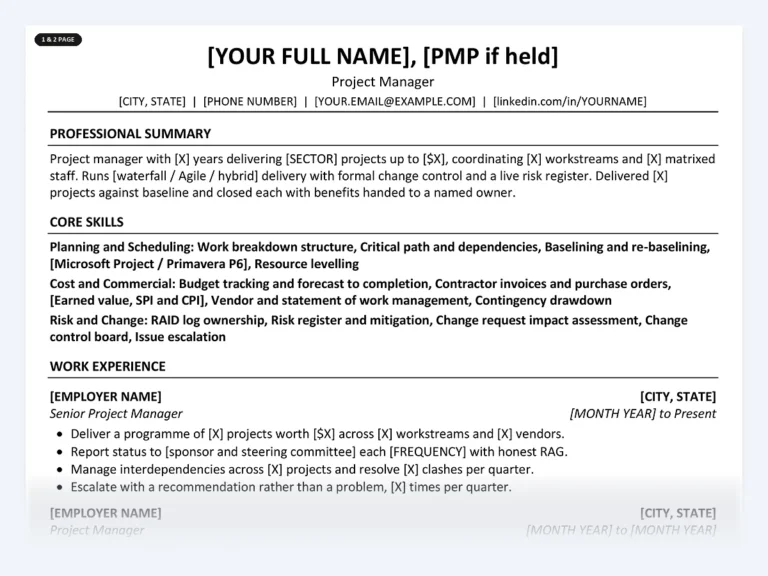
Project Manager Resume Kit
A finished project manager resume and cover letter, with the PMP line and bullets for change control, RAID logs and project closing, bracketed for your numbers.
The Career Kit adds 10 project manager interview questions with guidance, such as what to do when a sponsor adds scope with no change to the date.
Our guide to tailoring your resume to a job description uses the same close reading of the posting for the resume itself.
If you’re a registered nurse
- “What’s the usual patient assignment on this unit on days and on nights, and what happens when acuity goes up?” Assignments vary by unit and by facility staffing rules, so ask this unit, not the hospital.
- “How long is orientation, and will I have one preceptor or several?” New graduates should also ask whether there is a nurse residency program.
- “Is floating expected, and to which units?” A med/surg nurse floated to telemetry needs to know before accepting.
- “Is ACLS required at hire or within a window after?” Some federal postings give a window, such as a Walter Reed nursing posting that allowed six months from the start of employment.
- “Which EHR do you use, Epic, Cerner or Meditech?” Also ask whether the unit supports specialty certification such as the CMSRN once you’re eligible.
New graduates: our new grad nurse resume guide covers clinical rotations on the resume.
Questions to skip, and what to ask instead
A few questions cost more than they earn. Most are fine later, just not in a first interview with the hiring manager.
- “What does the company do?” The website answers it, and asking tells them you didn’t look.
- Anything they already covered. If you must, reference it: “You mentioned the new system. How far along is the rollout?”
- “How soon can I take vacation?” Save leave questions for the offer stage.
- “Did I get the job?” or “How did I do?” It forces a non-answer. Ask about the next steps instead.
- Yes-or-no questions. “Do you like working here?” gets “Yes.” “What do you like about working here?” gets a real answer.
- “Will I have to work late?” It sounds like a complaint. Ask what a busy period looks like instead.
What about salary?
Pay is a fair question; the timing matters. If the posting lists a range, you have your answer until the offer. If not, ask the recruiter in the first screen: “What’s the budgeted range for this role?” Leave it out of later rounds unless they raise it.
Nurses: expect the patient assignment question in reverse, so have your own unit, ratio and shift length ready.
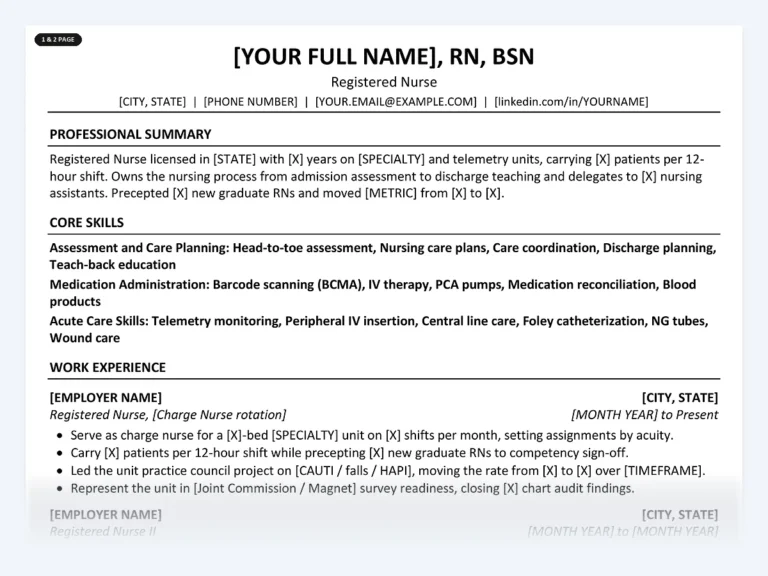
Registered Nurse Resume Kit
A finished RN resume with the license line, BLS and ACLS placed where screeners look, and brackets for your unit, EHR and numbers.
The Career Kit adds 10 RN interview questions with guidance, including how to answer “What is your typical patient assignment now?”
What to do with the answers
Write the answers down within an hour, before the next conversation blurs them. They give you two things.
First, your follow-up. The next-steps answer gives you a date, and one specific answer gives your thank-you note a line only someone in the room could write. “Your point about the vendor renewals in Q1 stuck with me” beats “Thank you for your time.”
Second, your decision. One vague answer is normal. Vague answers about success measures, feedback and why the role is open, all from the same interview, are a pattern. You’re allowed to say no to a job.
If the opening “Tell me about yourself” felt shaky, our guide to answering tell me about yourself fixes the first two minutes.
Common questions
How many questions should I ask at the end of an interview?
Two or three, from a prepared list of five or six. If the interviewer answered most of them already, ask one follow-up about something they said, and always ask about the next steps.
Is it bad to have no questions for the interviewer?
It reads as low interest, even when it isn’t. If everything really was covered, say so and ask one follow-up about something they said.
Can I read my questions from notes?
Yes. A notebook with your questions written down looks prepared, not nervous. Pick the ones that are still open.
What is a good last question to ask in an interview?
“What are the next steps, and when should I expect to hear from you?” It gives you a date for your follow-up and closes the conversation cleanly.
Get the interview questions written for your job
Find your role page to see three free interview questions with guidance on answering them. The Career Kit has ten, plus the resume, cover letter and keywords written for the same job title.
Find your job title
Written by
Founder, Disruptive Templates
Umair Sajid runs Disruptive Templates and has spent a decade in digital marketing, most of it looking at how people are found online. The resume templates here come from the same question asked of hiring software instead of search engines: what does the machine actually read?

Thank You Email After an Interview: Examples You Can Send Today
Send it within 24 hours, keep it to about 100 words, and include one detail only that interviewer would recognize. Examples for every kind of interview.

“Tell Me About Yourself”: How to Answer It in 90 Seconds
Present, past, future - in that order. The structure, five worked answers for different situations, and the five ways this question usually goes wrong.

Accountant Resume Examples: Entry Level to CPA
A controller wants three answers from your accountant resume: CPA status, the ERP you've closed the books in, and what you own. Here are examples that give them, from a…