
Resume writing8 min read
Server Resume Examples: Covers, Checks and Upselling
Managers read a server resume for section size, covers per shift and how you move the check. Here are bracketed examples for casual, fine dining, banquet and bartender-server jobs.

On this page
Key takeaways
- A server resume is read for its numbers: tables in your section at peak, covers per shift, how you moved the check, and your error or comp rate.
- Write upselling as guidance that moved the check by [X]%, not as pressure, and leave tip figures off entirely.
- Name your point of sale system and any food handler or alcohol server card with the issuer and state.
- Fine dining, casual, banquet and bar-and-floor jobs share a title and screen for different things. Lead with the one you’re applying for.
A strong server resume shows a manager, in the top third of the page, how big a section you run, how many covers you turn, and how you handle the kitchen when the room is full. Most server resumes list “friendly” and “team player” instead. Below are server resume examples for casual, fine dining, banquet and bartender-server jobs, with every number in [BRACKETS] for you to fill in. The restaurant server resume template has the full layout if you’d rather start from a written draft.
What a server resume needs in the top third

A floor manager hiring a server wants to know one thing first: can this person hold a section on a Friday night? Your summary answers it with numbers, not adjectives.
These are the numbers worth tracking before you write anything:
| Number | How to write it | Why a manager cares |
|---|---|---|
| Section size | [X] tables at peak | Shows how much of the room they can give you on day one |
| Covers per shift | [X] covers on a [weekend] shift | The fairest comparison between restaurants of different sizes |
| Check movement | Average check up [X]% over [PERIOD] | Shows selling skill without quoting your sales or tips |
| Errors and comps | Under [X] items sent back or comped a month | Every comp is food cost; low numbers mean accurate orders |
| Cash at close | [$X] or less variance across [X] shifts | Trust with the drawer |
Don’t know a number exactly? Estimate low. You should be able to explain it. A manager may ask what a busy Saturday looked like, and the answer should match the page.
Server resume bullet examples: covers, checks and upselling
Good server bullets describe the shift a manager is worried about: the full room, the late ticket, the allergy question, the drawer at close. Here are bullets for a casual or upscale casual floor, written so you can swap in your own numbers:
- Ran a [X]-table section at peak, serving [X] covers per [Friday and Saturday] shift at a [X]-seat restaurant.
- Raised my average check [X]% in [X] months by learning the menu and wine list well enough to recommend, not push.
- Warned tables about late tickets before they had to ask, on around [X] tickets a week, and fired courses with the kitchen on [X]-top parties.
- Kept comped or returned items from my orders under [X] a month by repeating every order and modifier back in [Toast / Aloha / Micros].
- Took every allergy question to the kitchen instead of answering from memory, about [X] a week.
- Closed [X] shifts a week with [$X] or less cash variance, and finished side work before checkout.
The late-ticket bullet matters more than it looks. Avoiding a table whose food is late is an easy habit to fall into. A line saying you walk over first tells a manager how you behave when the kitchen falls behind.
Notice what “upselling” looks like here. Managers want a server who raises the check because guests trust the recommendation, so write it that way. “Upsold desserts” says you push. “Raised average check [X]% by knowing the menu” says guests listened.
For the general method behind these lines, see how to write resume bullet points.
Fine dining vs casual vs banquet vs bartender-server resumes
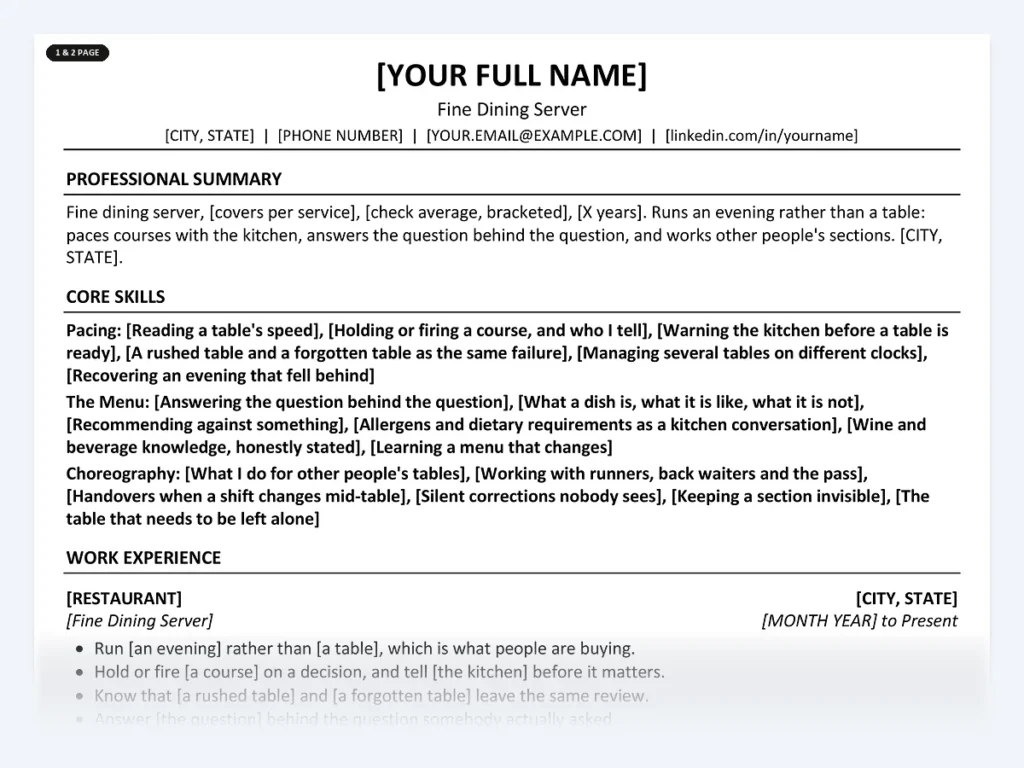
The same title covers very different jobs. Here’s what each one reads for first:
| Job | What the manager screens for | Lead your resume with |
|---|---|---|
| Restaurant server (casual) | Speed and volume with standards held | Section size, covers per shift, POS |
| Fine dining server | Pacing, menu depth, discretion | Service style, covers per service, check average, wine knowledge |
| Banquet server | Reliability on call and following the event plan | Venue types, largest event, service styles |
| Bartender and server | Working bar and floor in one shift, drawer control | Venue volume, cocktail specs, POS, ID checks |
Fine dining server resume example
Fine dining sells an evening, not a plate. Your bullets should show pacing and judgment:
- Paced [X]-course tasting menus for a [X]-cover room, holding or firing courses with the pass so no table waited or felt rushed.
- Answered menu and wine questions in a [tasting menu / a la carte] room with a [$X] check average, including recommending against a dish when it didn’t suit the guest.
- Handled every dietary request as a conversation with the kitchen before the order went in.
Banquet server resume example
Banquet work is a counted event run by a captain. Show you follow the plan and turn up when called:
- Served plated, buffet and [French / butler] service at events of up to [X] covers across [hotel, private club] venues.
- Plated dietary alternates to the named seat on the event sheet, and took any extra cover to the captain before serving it.
- Set and struck rooms to the floor plan for [X] events a month, carrying china and linen to a load-in deadline.
Bartender and server resume example
Two jobs in one shift. Show you can do both without the drawer or the section slipping:
- Worked bar and a [X]-table section in the same shift at a [VENUE TYPE] doing [X] covers a night.
- Poured [X] house cocktail specs to measure, the same way every time, and rang every item through [POS].
- Counted the drawer to the cent at close and reported any variance to the manager on duty immediately.
- Checked ID on every guest who looked under [AGE], and refused service when unsure.
Adjust the last bullet to your venue’s own ID policy. Bar-and-floor managers hire for control as much as speed, so the drawer and the ID check belong on the page even though every bartender does them. Most applicants leave them off because they seem obvious. That’s exactly why they stand out.
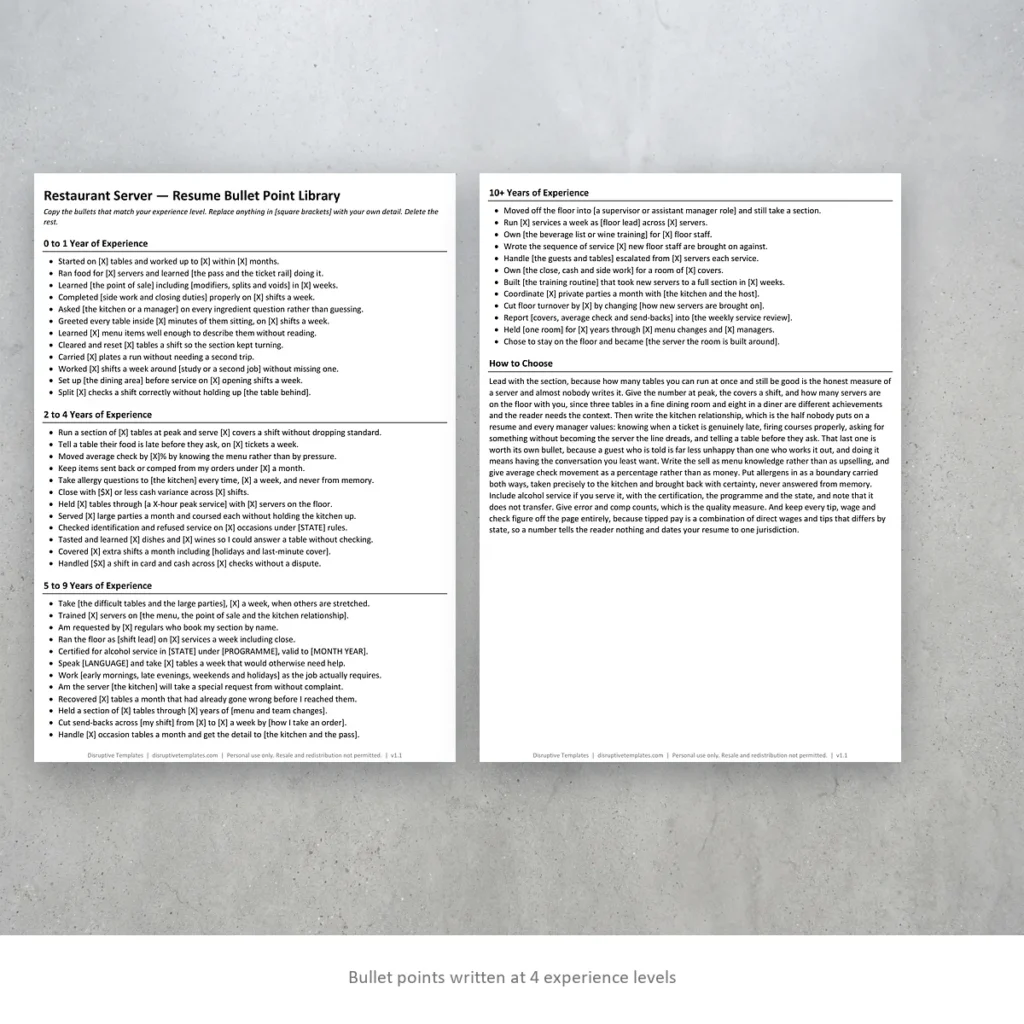
Restaurant Server Resume Kit
A one-page and two-page server resume with the section size, cover count and check lines already written. The Career Kit adds a bullet library in four experience bands and the ATS keywords server postings use.
Serving skills for a resume: what to list
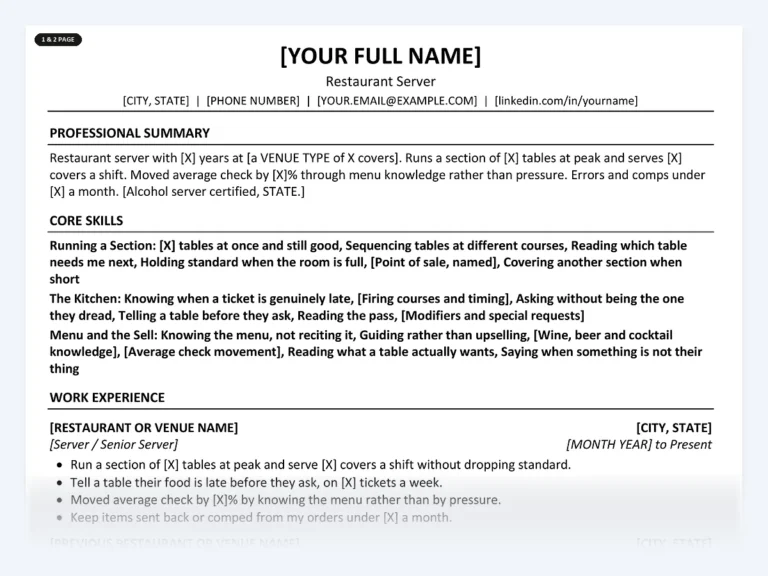
Skills sections on server resumes are often a list of soft words. Group yours by the parts of the shift instead, and name tools where you can:
- Running a section: sequencing tables at different courses, covering another section when short, [POS system: Toast, Aloha, Micros or Square].
- Working with the kitchen: firing courses and reading the pass, plus modifiers and special requests.
- Menu and beverage: menu knowledge, [wine, beer and cocktail knowledge], allergen questions to the kitchen.
- Money: splitting checks, handling cash and cards, voids only with a manager.
For certifications, write the exact name with the issuer and state: [ServSafe Food Handler, STATE, YEAR] or [ServSafe Alcohol / TIPS, STATE, expires MONTH YEAR]. Whether you need either card depends on your state, county or city, as the BLS Occupational Outlook Handbook notes, so check your local rules rather than assuming. Many server postings don’t name one at all, but a current card still saves a manager a question.
Customer-facing skills carry over from other jobs. If you’re coming from retail or a call center, our customer service resume skills guide shows how to word them, and skills for a resume covers the section layout.
What to leave off a server resume
- Tip amounts or hourly earnings. Tipped pay works differently by state, and a figure invites the wrong conversation.
- Your total sales in dollars. Give check movement as a percentage instead.
- Stories about guests, regulars or a bad table, even anonymized. Discretion is part of what’s being hired.
- Photos taken during service, of guests, the reservation book or the POS screen.
- “Answered allergy questions from menu knowledge.” Say you took them to the kitchen.
- Criticism of a past kitchen, manager or coworker.
Common questions
What should a server put on a resume with no experience?
Lead with anything that shows speed, cash handling or dealing with the public: fast food, retail, host or busser shifts, even volunteer events. Add a food handler card if your state issues one, and list your availability. Managers staff weekends first.
Should I put my tips on my resume?
No. Tipped pay combines wages and tips differently depending on the state, and the number says little about your service. Show check movement as a percentage and covers per shift instead.
How do I describe upselling on a server resume?
Tie it to menu knowledge and a result: “Raised average check [X]% by recommending wine pairings and specials.” Avoid words like “pushed” or “maximized sales”, which read as pressure.
Is a server resume one page?
Yes, for almost every server. A two-page version only makes sense with long fine dining or management experience. Put your most recent or most relevant restaurant first.
What POS systems should I list?
List the ones you’ve actually used, by name, such as Toast, Aloha, Micros or Square. If the posting names a system you haven’t used, say which similar one you know; managers expect you to learn theirs in a few shifts.
Start from a server resume that’s already written
The restaurant server kit has a one-page and a two-page resume, a cover letter and server bullets with brackets for your own numbers, as .docx files for Word, Google Docs and Pages. The page shows free sample bullets first.
See the restaurant server kit
Written by
Founder, Disruptive Templates
Umair Sajid runs Disruptive Templates and has spent a decade in digital marketing, most of it looking at how people are found online. The resume templates here come from the same question asked of hiring software instead of search engines: what does the machine actually read?

Security Guard Resume Examples: License, Posts and Incidents
Recruiters at security companies check your guard card before anything else. Here is where it goes, with bullets for each post type, incident report wording and an armed version.

Project Manager Resume Examples: Scope, Budget and Delivery
Lead with your method and credential, give every project a size line, and write bullets about what the plan met in real life. With IT, construction and agile versions.

Engineering Resume Templates: Civil, Electrical, Mechanical and More
Pick the engineering resume template for your discipline, then get the parts every engineering resume shares right: the discipline line, FE and PE placement, and project bullets with real scope.