
Resume writing10 min read
Software Engineer Resume Examples: Entry Level to Senior
A graduate and a staff engineer prove different things on paper. Here is what leads a software engineer resume at each level, with bullets to adapt and the lines recruiters skip.

On this page
Key takeaways
- On a software engineer resume, the layout barely changes from intern to senior. The evidence does: projects at entry level, shipped features at mid level, scope and decisions at senior level.
- Write the stack line the way postings write it. TypeScript and JavaScript are different search terms, and so are AWS and Azure.
- List the technologies you can defend in a technical screen. Five you know beats twenty you touched once.
- Every impact bullet needs a number you can explain: latency at a named percentile, requests served, CI time, incidents.
- Link GitHub only if the pinned repositories have READMEs and recent commits. An empty profile hurts more than no link.
Most software engineer resume samples online show one finished page for a mid-level engineer and call it done. The trouble is that a graduate and a staff engineer are proving different things, so copying the same sample puts the wrong evidence at the top. Below are examples for each level, with bullets you can adapt, the stack line that screeners search, and what recruiters skip. If you want a finished draft to edit, our software engineer resume template has the layout and bullets already written.
What every software engineer resume needs, at any level

Four things sit at the top of every good engineering resume: your name and links, a two-line summary, a stack line, and your strongest evidence. What counts as the strongest evidence is the part that changes with seniority.
| Level | Lead section | What it has to prove | Length |
|---|---|---|---|
| Intern | Projects and coursework, then any placement | You can ship something small and ask for help at the right time | 1 page |
| Entry level | Projects you chose, then internships | You make decisions and can work inside someone else’s rules | 1 page |
| Mid level | Experience | You own features end to end, from loose requirement to production | 1 page, 2 if the work earns it |
| Senior and staff | Experience, framed by scope | Your judgement changes what other engineers and teams do | 2 pages |
The stack line
Put a short, grouped skills section near the top, and name each technology exactly as the postings you want name it. Recruiters search their applicant tracking system for strings like “TypeScript”, “Kubernetes” or “GitHub Actions”. “JavaScript frameworks” matches none of them.
The “before” list is the one the technical screen punishes. An interviewer picks the weakest item on it, and a keyword match on something you cannot discuss gets you an interview you then lose. Group the “after” the way the work divides, and cut anything you only met in a tutorial.
Links: GitHub, portfolio, LinkedIn
Put your GitHub and LinkedIn URLs in the header as plain text, not icons. Screeners and parsing software both read text; an icon without a URL gives them nothing.
Link GitHub only if a stranger would learn something there in two minutes. That means two or three pinned repositories, a README that says what each one does and how to run it, and commits that are not all from one weekend. If the profile is empty or abandoned, leave it off. A live demo link beside a project is worth more than the repository link, because it proves the thing runs.
Entry level and computer science resume examples: projects before experience

If this is your first resume for software engineering jobs, stop apologizing for the missing job title and use what you do have. The usual graduate resume opens with education, lists three tutorial clones by name, and ends with a skills list of eighteen technologies. It fails because it describes what was built and never what was decided. A reader cannot tell whether you followed a video or solved a problem.
Use one test on every project before it earns a line: can you finish the sentence “I chose ___ instead of ___ because ___”? If you can’t, the project is a tutorial. Mention it in a list, not a section.
Order the project section with work you chose first and coursework last. A project nobody assigned or graded is stronger evidence than a class assignment, and the ordering itself tells the reader you know that. Four real users, stated honestly, beats a thousand you cannot account for. The first interview question about any number is where it came from.
The line most graduates leave out
A merged pull request in a project you did not start is the closest thing to professional experience available before your first job. It proves you can read someone else’s code, follow their conventions and take review. Write it as a bullet: “Contributed [a fix to date parsing] to [project name]; revised it [3] times to meet the maintainer’s [test and style] requirements before merge.”
Intern resumes: deployed beats written
For internships, lead with anything that reached production, even something small. “Shipped [a retry wrapper for the payments client] to production in week [3]; it runs on every [checkout request]” tells a reviewer more than a list of courses. Then show you were easy to work with: you asked early, and you handed the work over documented to a named person before you left.
For the rest of a first resume, see our guide to a resume with no experience.
Mid-level software engineer resume example: impact bullets
Once you have two to four years in the job, experience leads and projects shrink to a line or disappear. The evidence is now the features you owned end to end and the systems you kept running. Each bullet follows one shape: what you did, the system and scale, and what changed.
Here are more bullet shapes that work at this level. Replace every bracket with your own numbers, and only use a number you can explain in an interview.
- Owned [bulk export for enterprise accounts] from a one-line request to a [canary] release, plus [4] smaller features taken the same way through design and tests.
- Built and maintain [12] REST endpoints used by [the mobile app and 3 partner integrations], with contract tests in CI.
- Reduced CI pipeline time from [25] to [9] minutes by [parallelizing test suites in GitHub Actions], so the team merges [more often].
- Took the on-call rota for [the orders service]; led [4] incident reviews and closed the root cause on [a recurring timeout].
- Reviewed [8 to 10] pull requests a week and wrote the team’s [testing checklist] for new services.
Latency needs a percentile (p95, p99), and volume needs a period. “Improved performance by 40%” invites the question “40% of what?”, and if you can’t answer it, the bullet costs you. If your employer never shared the number, describe the change and the system instead. Our guide to resume bullet points covers the pattern for any job.
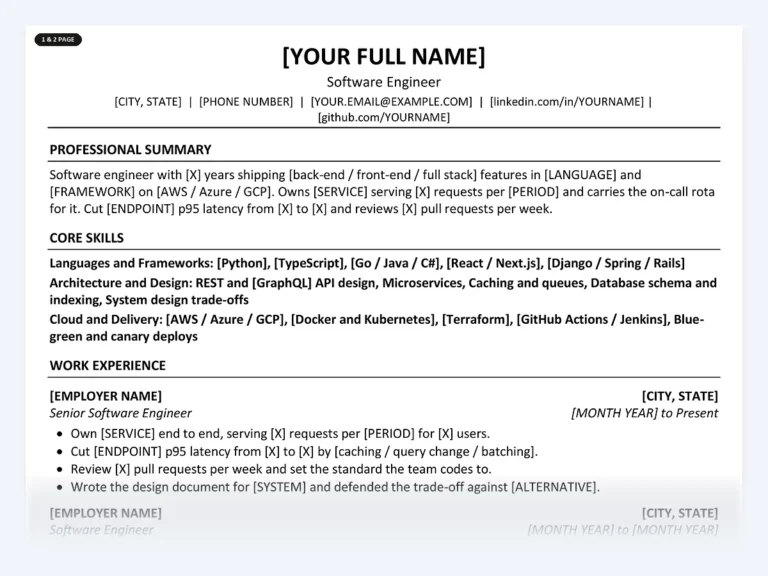
Software Engineer Resume Kit
A finished 1-page and 2-page software engineer resume with the stack line and bullets written. You replace the brackets with your own systems and numbers.
The Career Kit adds a 48-bullet library in four experience bands, an ATS keyword bank grouped by hard skills, tools and certifications, and interview questions for the role.
Senior software engineer resume: scope, not a longer list

The most common senior resume reads like a mid-level resume with more detail: more systems, more languages, more features. That document gets a strong engineer leveled down, because nobody is promoted to senior or staff for volume of output. They are promoted for how far their judgement reaches beyond their own keyboard.
Titles also don’t travel well. A senior title at a fifty-person company and one at a large tech company can be two levels apart, and anyone who has hired across companies knows it. So the resume has to show scope rather than state a title. For each role, make it clear whether your work changed your team, several teams or the whole organization.
Senior evidence comes in a few kinds, and your bullets should cover them:
- Decisions and trade-offs. What you chose, what you rejected, and what the choice saved.
- Problems that stopped happening. Write it as a change in how often a class of problem occurs, not a single fix.
- People. Engineers you mentored who now own their own areas, and people you put forward for bigger work.
- Glue work. The cross-team migration nobody owned, or the onboarding that would not have happened. Hiring managers who have run teams recognize it immediately.
At this level you also choose a track. A principal engineer resume and an engineering manager resume are different documents. Pick the one you are applying for, and say so in the summary. Our senior software engineer kit is written around that choice.
What recruiters skip on a software engineer resume
These are the lines that take space and earn nothing on a resume for software engineers, at any level:
- Skill bars or star ratings next to languages. “Python 80%” means nothing to a reader and parses badly.
- An objective like “Seeking a challenging role to grow my skills”. Say what you have instead.
- Soft-skill lists (“team player, fast learner”). Show them in bullets about code reviews and incidents.
- Employer source code, internal architecture diagrams or screenshots. That is a confidentiality problem, not a portfolio.
- Two-column designs and text boxes. Many applicant tracking systems read them out of order. Our ATS-friendly resume format guide shows the safer layout.
- Certifications you don’t use. An AWS Certified Developer or Certified Kubernetes Administrator (CKA) credential helps when the role runs on that platform. A stack of unrelated ones reads as padding.
A computer science degree goes under education with the year. It is not required for many roles: federal IT specialist postings in the 2210 series accept experience in place of a degree, and many private employers have dropped the requirement. Bootcamps and self-taught routes belong in the same section, stated plainly.
Common questions
Should a software engineer resume be one page or two?
One page for interns, graduates and most engineers with under five years. Two pages once you have senior-level scope to show, such as design decisions and cross-team work. Never pad to reach a second page.
How many projects should an entry-level software engineer list?
Two or three, each with what it does, who uses it and one decision you made. A single project you kept working on for months is stronger than five you finished in a weekend. Tutorial builds can go in one short line, if at all.
Do I need a GitHub link on my resume?
Only if it helps. A profile with pinned, documented repositories and steady commits is good evidence, especially at entry level. An empty or abandoned profile is worse than no link, so leave it off until it shows real work.
Are certifications worth listing for software engineers?
Less than in most fields. List a cloud or Kubernetes certification when the posting’s stack uses that platform, with the exact name, such as AWS Certified Solutions Architect Associate. Code and design evidence carry more weight than any certificate.
What if I can’t share numbers from my current job?
Describe the system, the scale in general terms and the change you made, for example “cut p95 latency on a high-traffic search endpoint by [roughly half]”. Never invent a figure. Interviewers ask how every number was measured.
Start from a software engineer resume that is already written
The software engineer kit has the stack line and bullets in place for your level. Edit it in Word or Google Docs, and see the free sample bullets on the page first.
See the software engineer kit
Written by
Founder, Disruptive Templates
Umair Sajid runs Disruptive Templates and has spent a decade in digital marketing, most of it looking at how people are found online. The resume templates here come from the same question asked of hiring software instead of search engines: what does the machine actually read?

Server Resume Examples: Covers, Checks and Upselling
Managers read a server resume for section size, covers per shift and how you move the check. Here are bracketed examples for casual, fine dining, banquet and bartender-server jobs.

Security Guard Resume Examples: License, Posts and Incidents
Recruiters at security companies check your guard card before anything else. Here is where it goes, with bullets for each post type, incident report wording and an armed version.

Project Manager Resume Examples: Scope, Budget and Delivery
Lead with your method and credential, give every project a size line, and write bullets about what the plan met in real life. With IT, construction and agile versions.