
Interviews9 min read
Thank You Email After an Interview: Examples You Can Send Today
Send it within 24 hours, keep it to about 100 words, and include one detail only that interviewer would recognize. Examples for every kind of interview.

On this page
Key takeaways
- Send a thank you email after the interview the same day, or within 24 hours at the latest.
- Three short parts do the work: thanks with one specific detail from the conversation, the point you wish you had made, and the next step.
- Write a separate email to each person you met. Each one gets a different detail, because panel members compare notes.
- If you hear nothing, send a short follow-up the working day after the date they gave you, and at most one more a week later.
A thank you email after an interview should go out within 24 hours, run to about 100 words, and mention one thing from the conversation that only you and that interviewer would recognize. That detail is what separates a note that gets read from one that gets archived.
Below are examples you can adapt for a hiring manager, a phone screen, a video call, a panel, a second round and the follow-up when nobody replies. Applying for office roles? The administrative assistant resume kit page shows free sample bullets and interview questions for that job.
When to send a thank you email after an interview

Send it the same day if you can, and within 24 hours at the latest. Hiring teams often meet to compare candidates soon after the last interview, and a note that arrives after that meeting can’t help you.
- Morning interview: send it that afternoon.
- Late-afternoon interview: send it the next morning, so it lands at the top of their inbox.
- Friday interview: send it Friday. Monday morning is when the pile is biggest.
- Final round with a decision “by end of day”: send it as soon as you get home, well before the team meets.
Don’t send it from the parking lot. A note that arrives five minutes after you leave reads like a template you had ready. Give it an hour and write it with the conversation fresh.
Who to send it to
Everyone who interviewed you, one email each. If you don’t have someone’s address, reply to the recruiter’s scheduling email and ask them to pass your thanks on, naming each person. Don’t guess an address from the company’s email format; a bounced message or a stranger’s inbox helps nobody.
The three-line thank you email structure
Most thank you notes are too long and too general. The version that works has three parts, and each part is a sentence or two.
- Thanks, with one specific detail. Name something they said, not something you said. “Thank you for walking me through how the team splits the Monday executive reports” proves you were listening.
- The point you wish you had made. Everyone leaves an interview with a better answer they thought of on the drive home. This is where it goes, in one or two sentences.
- The next step. Repeat the timeline they gave you and say you’re available if they need anything else.
The “before” could come from any candidate for any job. The “after” could only come from someone who sat in that interview. That is the whole test.
Subject lines that get opened
Keep it plain and searchable, because the interviewer may look for it later when they write up their notes:
- Thank you: [Job title] interview, [Day]
- Thanks for today, [Job title] conversation
- Following up on our [Job title] interview
If you’re replying in an existing thread with the recruiter, keep their subject line so it stays in the same conversation.
Thank you email examples for every kind of interview

Each example below keeps the three-line structure. Replace everything in brackets, and cut any sentence that doesn’t fit what really happened in your interview.
After an in-person interview with the hiring manager
Hi [Name],
Thank you for meeting with me today and for the tour of the office. Hearing that [the CFO] travels [two] weeks a month helped me picture the role. One thing I didn’t mention: I booked and reconciled travel in Concur for [two] executives at [Employer], including the expense reports. I’d be glad to talk through how I handled last-minute changes.
You mentioned a decision by [Friday]. Please let me know if you need anything before then.
[Your name]
[Phone]
After a phone screen with a recruiter
Shorter. The recruiter’s job is to move you to the next round, so confirm interest and remove any friction.
Hi [Name],
Thanks for the call this morning and for explaining the [two]-round process. I’m still very interested. As we discussed, I’m available for the next interview any weekday after [2 p.m.], and my [start date / notice period] is [two weeks].
[Your name]
After a video interview
Same structure as in person. Don’t mention the dropped connection or the dog barking unless it caused a real problem; if it did, offer to go over anything that got lost.
Hi [Name],
Thank you for the call today. I liked hearing how your team runs weekly QA calibration, so everyone is graded against the same scorecard. When you asked about a low QA score, I should have added what happened next: my [empathy] score went from [X] to [X] over the following [month] after I rebuilt my opening from the calls my team lead flagged.
I know you’re speaking with other candidates this week. I’m happy to answer anything else.
[Your name]
After a panel interview
Write one email per person, sent separately, not one email copied to the whole panel. Panel members compare notes, and three identical emails read like one email. Change the detail line for each person, based on what they asked.
| Panel member | What they asked about | Your detail line |
|---|---|---|
| Hiring manager | Priorities in the first 90 days | “Your point about getting the ticket backlog under [X] by spring stuck with me.” |
| Team lead | Handling an angry customer | “Thanks for the scenario about the billing error. I’d add that I always confirm what I can credit before promising it.” |
| Peer on the team | What a normal shift looks like | “It was useful to hear how chat and phone are split across the day.” |
After a second or final round
By now they know your background, so skip the recap. Connect the two rounds and answer anything left open.
Hi [Name],
Thank you for the second conversation, and for introducing me to [Name] and [Name]. After the first round I was interested; after today I’d like the job. You asked how I’d handle [the switch to the new phone system]. I’ve since read [the vendor’s admin guide] and would start by [shadowing the two reps who tested it]. Happy to go further on that.
[Your name]
That line, “I’d like the job,” is fine to write in a final-round note. It’s clear, and most hiring managers like knowing an offer will be accepted.
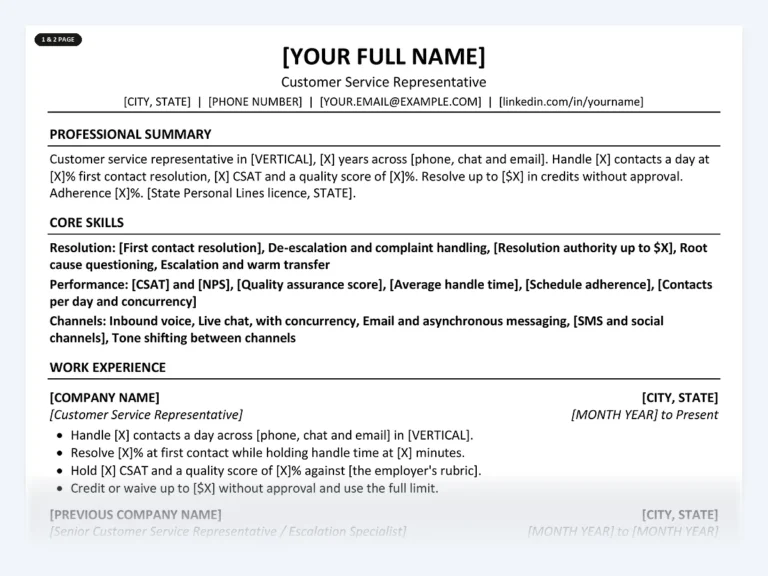
Customer Service Representative Resume Kit
A finished resume and cover letter for customer service jobs, with bullets for QA scores, handle time and adherence, bracketed for your numbers.
The Career Kit adds 10 interview questions for the role, recruiter outreach scripts that include a post-interview follow-up, and a guide to when to chase and when to stop.
Follow up email after an interview when you hear nothing

This is a different email from the thank-you note, and timing is everything. Wait until the working day after the date they gave you. If they gave no date, wait about a week. That is why the best end of interview question is “When should I expect to hear from you?” Our list of questions to ask the interviewer has more like it.
Hi [Name],
We spoke on [date] about the [Job title] role, and you expected to decide by [date]. I wanted to check where things stand. I’m still interested, and I’ve been thinking about [the scheduling problem you described]; I’d start by [one concrete step].
If you’ve gone with someone else, I’d appreciate knowing so I can close it out.
[Your name]
Send one follow-up, then a second a week or so later if you still hear nothing. After that, stop chasing and keep applying. Silence is common and usually says more about the employer’s process than about you.
Mistakes that undo a good thank you note
- Copying the same email to every interviewer, or sending one email with the whole panel in the To line
- Recapping your resume. They have it. One new point beats five old ones.
- Attaching work nobody asked for. Offer it instead: “I can send the [training guide] I mentioned.”
- Misspelling the interviewer’s name or the company’s. Check both against their email signature.
- Apologizing at length for a weak answer. Fix it in one sentence with the better answer and move on.
- Asking “Did I get the job?” The next-step line covers it.
Email or handwritten thank you note?
Email first, always, because it arrives before the decision. A handwritten thank you note after the interview can follow for a small office or a local business, and some people still appreciate one, but it shouldn’t replace the email. Keep it to three sentences and send it the same day.
And if you want the start of the interview to be as strong as the finish, our guide to answering tell me about yourself covers the first two minutes.
Common questions
How soon should I send a thank you email after an interview?
The same day if you can, and within 24 hours at the latest. Wait about an hour after you leave so the note reads as written, not pre-loaded, and send a late-afternoon interview’s note the next morning.
How long should a thank you email be?
About 100 words: three short parts and your name. Longer notes tend to repeat the resume, which the interviewer already has.
Should I send a thank you email after a phone screen?
Yes, a short one. Thank the recruiter, confirm you’re still interested, and give your availability for the next round. Two or three sentences is enough.
Is it too late to send a thank you email after two days?
Send it anyway, without apologizing for the delay. A specific note two days later is better than none, as long as no decision has been announced.
What if I don’t have the interviewer’s email address?
Reply to the recruiter or coordinator who scheduled the interview and ask them to pass on your thanks, naming each interviewer. Don’t guess an address from the company’s email pattern.
Walk into the next interview with the job’s questions already prepared
Find the page for your job title to see free sample bullets and three interview questions with guidance. The Career Kit adds ten questions, the follow-up scripts and the resume written for the same job.
Find your job title
Written by
Founder, Disruptive Templates
Umair Sajid runs Disruptive Templates and has spent a decade in digital marketing, most of it looking at how people are found online. The resume templates here come from the same question asked of hiring software instead of search engines: what does the machine actually read?

Questions to Ask the Interviewer (and What Each Answer Tells You)
Thirty questions to ask at the end of an interview, grouped by what you want to find out, with what a good answer and a weak answer sound like.

“Tell Me About Yourself”: How to Answer It in 90 Seconds
Present, past, future - in that order. The structure, five worked answers for different situations, and the five ways this question usually goes wrong.

Server Resume Examples: Covers, Checks and Upselling
Managers read a server resume for section size, covers per shift and how you move the check. Here are bracketed examples for casual, fine dining, banquet and bartender-server jobs.