
Resume writing12 min read
Nursing Resume Examples and Skills for Every Specialty
Put your license right under your name, give every job its unit, ratio and EHR, and write bullets for the specialty you are applying to. Examples for ICU, ER, med-surg, pediatrics, labor and delivery and the OR.

On this page
Key takeaways
- Put your license right under your name: the state and number, plus multistate status if you hold a compact license.
- Every nursing job entry needs three facts a recruiter filters on: the unit and its size, your usual patient ratio, and the EHR you charted in.
- Each specialty is read for a different thing first. ICU for ratio and drips, ER for triage and volume, L&D for fetal monitoring and NRP.
- List nurse skills by specialty, using the posting’s own wording, and give every certification its issuing body and expiry date.
- New grads without an RN job should follow a different order, covered in our new grad nurse resume guide.
A strong nursing resume answers three questions before the reader finishes the top third: are you licensed where they are hiring, what kind of unit have you worked, and how many patients did you carry. Everything else supports those answers.
Below are nursing resume examples for six specialties, the skills each one gets screened for, and the bullets that prove them. If you’d rather edit a finished draft, the registered nurse resume template follows this order. Still waiting on your first RN job? Use the new grad nurse resume guide instead, because your evidence sits in different places.
The nursing resume order recruiters read

Hospital recruiters screen for eligibility first and fit second. The order below puts both where they look.
- Name and license line. “Jordan Lee, BSN, RN” on line one, then the license itself on line two.
- Summary. Three lines: specialty and years; unit and ratio; the credential that matters most for this posting.
- Licenses and certifications. Its own short section, near the top, not buried under education.
- Clinical experience. Newest job first. Unit, bed count, ratio, EHR, then bullets.
- Education. Degree, school, year. Accreditation (ACEN or CCNE) is worth adding.
- Skills. Grouped by clinical area, matched to the posting.
Why the license goes so high: postings state it as a hard requirement, and the wording is strict. One Department of Veterans Affairs RN announcement asks for “current, full, active, and unrestricted registration” in a US state or territory (USAJOBS). A recruiter checking that box wants it on the page in seconds, not on page two.
Add the compact line only if your license is multistate. Hospitals near a state border and travel agencies look for it, and a single-state license is never a problem to state plainly. Which states belong to the compact changes as states join, so check the current map on the NCSBN’s Nurse Licensure Compact site before you describe where you can practice.
Put the unit and your ratio in every job entry
Most nursing resumes list duties every nurse performs: “assessed patients, administered medications, educated families.” A recruiter learns nothing from that, because every applicant for the job did the same. What separates you is the setting, and three facts describe it.
The first is the unit and its size: “32-bed medical-surgical unit” or “24-bed mixed MICU/SICU.” A 10-bed critical access ICU and a 30-bed trauma ICU are different jobs with the same title. The second is your usual ratio. Ratios vary by state law and by unit acuity, so there is no standard number to copy; write your own. The third is the EHR you charted in, whether that’s Epic, Cerner or Meditech.
Recruiters often look for the system name, since a nurse who already charts in it needs less time learning the software.
Put those facts in a one-line description under the job title, then keep the bullets for what you did with them.
Scanned every dose through barcode medication administration, keeping unit scanning compliance at [98]% for [4] straight quarters.
Numbers you can usually find: your ratio, the bed count, how many new grads or students you precepted, how many charge shifts you took a month, and any unit measure you helped move, such as falls, CAUTI or hospital-acquired pressure injuries. If you don’t know the exact figure, leave the bracket and ask your manager or unit educator. Don’t estimate a quality rate from memory. For more on the structure behind strong bullets, see how to write resume bullet points.
Nursing resume examples by specialty

A nurse resume example that works for one unit reads wrong for another. Each specialty’s hiring manager scans for a different first fact. Here is what each one looks for, and sample bullets you can adapt. Keep the brackets until you have your own numbers.
Medical-surgical nurse
Med-surg managers read for breadth and judgment. How many patients did you carry, how varied were they, and do you catch the patient who is quietly getting worse? The specialty has two certifications, and postings name one or the other: CMSRN from the Medical-Surgical Nursing Certification Board and MEDSURG-BC from the American Nurses Credentialing Center. Write the one you hold by its exact name.
- Cared for [5 to 6] adult medical and post-surgical patients per shift across [cardiac, renal and orthopedic] diagnoses.
- Called a rapid response on a post-op patient whose [heart rate and mental status] changed before any vital sign crossed a threshold.
- Taught discharge medications and warning signs by teach-back to [X] patients a week on the unit’s [heart failure] pathway.
Full example: medical-surgical nurse resume.
ICU nurse
ICU managers read for the ratio, the unit type (MICU, SICU, CVICU, NSICU) and what you have actually run: vasoactive drips, ventilated patients, CRRT. The credential they look for is CCRN from the American Association of Critical-Care Nurses. Both of its eligibility routes require direct-care hours in the most recent year, so a current CCRN tells a reader you are practicing critical care now. Say “current to [Month Year]”.
Some employers go further. One Eisenhower Health ICU posting listed CCRN and two years of intensive care experience as requirements.
- Carried [1:1 or 2:1] assignments in a [24]-bed [mixed medical-surgical] ICU at a [Level I trauma center].
- Titrated [norepinephrine, propofol and insulin] infusions to ordered targets within unit protocol, documenting every change in the flowsheet.
- Served as the unit’s [CRRT] resource nurse, troubleshooting circuits for [X] colleagues across [day and night] shifts.
Full example: ICU nurse resume.
Emergency room nurse
ER managers read for triage first, then volume and the emergency courses. Describe the department before anything else: annual visits and treatment spaces; trauma or stroke designation if it has one. The credentials are CEN from the Board of Certification for Emergency Nursing, which renews every four years, and TNCC and ENPC from the Emergency Nurses Association. List BLS, ACLS and PALS with expiry dates, since ER postings often ask for all three.
- Triaged [30] patients a shift using ESI in a [45]-bed department seeing [70,000] visits a year.
- Took the [primary nurse] role in [X] trauma and stroke activations a month, from arrival to CT.
- Reassessed the waiting room every [hour], up-triaging [a septic patient] who had arrived looking stable.
Full example: emergency room nurse resume.
Pediatric nurse
Pediatric managers read for the age range you cover and how you work with parents. A Defense Health Agency pediatric posting described care tailored to developmental and age-specific needs, family education on home care, and follow-up phone calls with parents about managing illness. That last duty rarely appears on a resume, and it should. PALS belongs in your certifications. If you hold CPN from the Pediatric Nursing Certification Board, name it in full.
- Cared for [3 to 4] patients aged [newborn to 17] on a [20]-bed general pediatric unit, adjusting assessment and pain scoring to each child’s age.
- Made follow-up calls to [X] families a week after discharge, catching [two] readmission risks from what parents described.
- Precepted [X] nurses transferring from adult units through pediatric weight-based medication competencies.
Full example: pediatric nurse resume.
Labor and delivery nurse
L&D managers read for fetal monitoring and the certification stack. Postings we read asked nurses to interpret continuous electronic fetal monitoring using NICHD terminology, carry two to three laboring patients at once, and hold NRP, BLS and fetal monitoring training, named as AWHONN or Intermediate Fetal Monitoring, with ACLS depending on the hospital’s level of care. Several of those postings described an orientation of 12 to 16 weeks, so experienced L&D nurses should say how long they have practiced independently.
- Managed [2 to 3] laboring patients per shift on a unit delivering [3,000] babies a year, including oxytocin inductions and epidurals.
- Interpreted fetal heart rate tracings in NICHD categories and escalated [Category II] changes to the provider with SBAR.
- Ran [quarterly] postpartum hemorrhage and shoulder dystocia drills for [X] staff as the unit’s simulation lead.
Full example: labor and delivery nurse resume.
Operating room nurse
OR managers read for your role in the room and the services you cover. The title hides two jobs: the circulating nurse runs the room, the documentation, positioning and the count, while the scrub nurse works at the sterile field. Say which you do, or both. Then name the services, because postings recruit by service and an orthopedic room is not a cardiac one. The specialty credential is CNOR from the Competency and Credentialing Institute.
- Circulated and scrubbed [general, orthopedic and robotic] cases across [8] ORs, running [4] to [6] cases a day as circulator.
- Stopped a closing count that didn’t reconcile and held it until the [sponge] was found, following [facility] count policy.
- Took [weekend] call for a [Level II trauma center] OR [2] times a month.
Full example: operating room nurse resume.
Registered Nurse Resume Kit
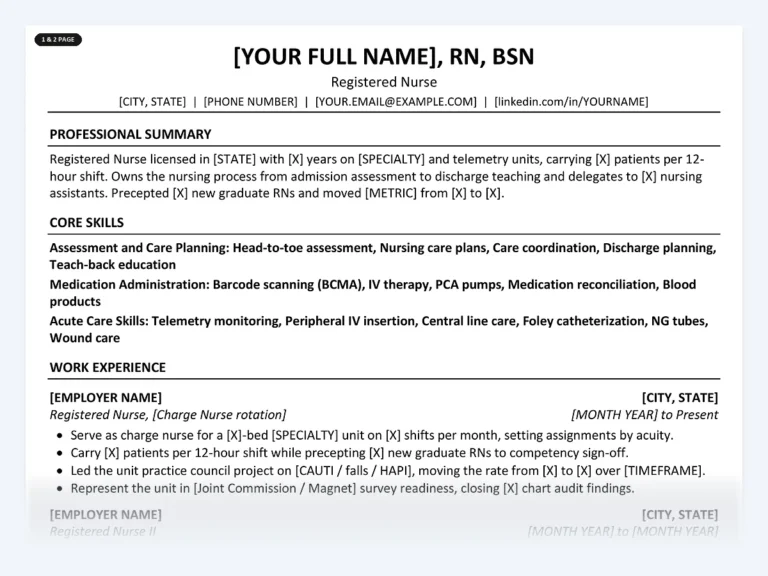
A finished RN resume with the license line and certifications at the top and unit details under each job, in the order recruiters read. The Career Kit adds a 48-bullet library across four experience levels, an ATS keyword bank and interview questions for RN roles.
Each specialty above has its own kit, written from that unit’s postings, if you want the bullets already written for your floor.
Nurse skills for a resume, by specialty

The skills section is where an ATS matches your resume to the posting, so use the posting’s words. If it says “telemetry monitoring,” don’t write “cardiac rhythm reading.” Group the skills by clinical area so a human reader sees your practice at a glance.
| Specialty | Clinical skills to list | Tools and systems | Credentials |
|---|---|---|---|
| Med-surg and general RN | Head-to-toe assessment, medication administration, IV therapy, wound care, discharge teaching, delegation | Epic, Cerner or Meditech; BCMA; Pyxis or Omnicell; PCA pumps | BLS, ACLS, CMSRN or MEDSURG-BC |
| ICU | Hemodynamic monitoring, vasoactive titration, ventilator care, sedation scoring (RASS), CAM-ICU | Arterial lines, central lines, CRRT, smart pumps | BLS, ACLS, CCRN |
| Emergency | Triage (ESI), resuscitation, stroke, STEMI and sepsis pathways, de-escalation | 12-lead ECG, point-of-care testing, tracking board | BLS, ACLS, PALS, CEN, TNCC, ENPC |
| Pediatrics | Age-specific assessment, weight-based medication checks, family teaching, pediatric pain scales | Pediatric pumps and equipment | BLS, PALS, CPN |
| Operating room | Circulating, scrubbing, surgical counts, patient positioning, sterile technique | OR scheduling and documentation in the EHR | BLS, CNOR |
| Labor and delivery | Fetal monitoring interpretation, oxytocin management, newborn assessment, postpartum hemorrhage response | Continuous EFM, epidural support | BLS, NRP, fetal monitoring certification, ACLS where required |
Soft skills still count, but show them instead of listing them. “Compassionate communicator” is a claim. “Taught [6] discharging patients a week their medications by teach-back” is evidence of the same thing. Keep the skills list to hard, searchable terms and let the bullets carry the rest.
To see which terms a specific posting wants, paste it into the free ATS keyword checker along with your resume. It shows the words you haven’t used yet.
Nursing resume summary examples
Three lines. Line one: specialty and years, plus your license. Line two: your unit and your strongest evidence. Line three: the credential or strength this posting asks for.
The before versions could belong to any nurse in the country. The after versions could only belong to one. More formats and examples are in how to write a resume summary.
What to leave off a nursing resume
- Your full license number on a resume you post publicly on job boards. Give the state and status there; send the number when you apply directly.
- Duties every nurse performs, such as “administered medications” with no unit, ratio or result.
- Expired certifications, unless you list the renewal course date.
- Patient details or unit stories that could identify anyone.
- Clinical rotations, once you have a year or more as an RN.
- Credentials you are “working toward” with no exam or course date.
- A references line. Employers ask for references later, usually near the offer.
Common questions
How long should a nursing resume be?
One page for under about five years of experience, two pages for more, or when you have several specialties, charge experience and certifications to list. Nurse managers and educators often need two. See how long should a resume be for the full rule.
Should I put my nursing license number on my resume?
On a resume you send straight to a hospital, yes, with the state and expiry, because it speeds verification. On a resume you post on public job boards, list the state and “active” and hold back the number.
What are the most important skills for a registered nurse resume?
The ones in the posting you are applying to, written in its words. For most RN roles that means patient assessment, medication administration, IV therapy, EHR charting in a named system, and BLS and ACLS. Specialty roles add their own: titration for ICU, triage for ER, fetal monitoring for L&D.
How do I write a nursing resume when changing specialties?
Lead with the skills that transfer, such as rapid response calls, telemetry or precepting, and add any course you have taken for the new specialty, like PALS for pediatrics or NRP for L&D. Say in your summary which unit you are moving to and why your current one prepared you.
Should a new grad nurse use this format?
Not quite. Without RN experience, education and clinical rotations move above work history, and license status is often “pending” or “exam scheduled.” Our new grad nurse resume guide covers that order.
Start from a finished nursing resume
The registered nurse kit puts the license line and certifications where recruiters check first, with brackets for your ratio and bed count. Edit it in Word, Google Docs or Pages. The role page shows free sample bullets first, and links to each specialty kit.
See the registered nurse kit
Written by
Founder, Disruptive Templates
Umair Sajid runs Disruptive Templates and has spent a decade in digital marketing, most of it looking at how people are found online. The resume templates here come from the same question asked of hiring software instead of search engines: what does the machine actually read?

Server Resume Examples: Covers, Checks and Upselling
Managers read a server resume for section size, covers per shift and how you move the check. Here are bracketed examples for casual, fine dining, banquet and bartender-server jobs.

Security Guard Resume Examples: License, Posts and Incidents
Recruiters at security companies check your guard card before anything else. Here is where it goes, with bullets for each post type, incident report wording and an armed version.

Project Manager Resume Examples: Scope, Budget and Delivery
Lead with your method and credential, give every project a size line, and write bullets about what the plan met in real life. With IT, construction and agile versions.