
Resume writing9 min read
How to List References on a Resume (and When Not To)
Should you put references on a resume? No: they belong on a separate page you send only when an employer asks. Here is how to format it, who to ask, and how to prepare them for the call.

On this page
Key takeaways
- Don’t put references on your resume. Keep them on a separate page and send it only when an employer asks.
- Delete “references available upon request.” Employers assume it, and the line costs you space you need for results.
- Pick three people, strongest first: a recent direct manager, an earlier manager, and one person who saw your work from another angle.
- Ask before you list anyone, then send them the job posting, your resume and a few lines on what the role needs.
- Each entry needs a name, job title, employer, how you know them, a phone number and an email address.
Skip references on a resume and put them on a separate page, handed over only when an employer asks for it. That is the whole answer to where they go. The harder part is choosing the right three people and preparing them so the call helps you. This guide covers the format, who to ask, a request email you can adapt, and the mistakes that turn a reference check into a problem.
Should you put references on a resume? Use a separate page

Your resume has one job: get you an interview. A list of names and phone numbers does nothing for that, and it takes space from the results that do. Most employers only call references after interviews, when they are close to an offer. So the page they need comes later in the process, as its own document.
There is also a courtesy reason. A resume gets forwarded, uploaded to job boards and saved in systems you will never see. Your former manager did not agree to have their mobile number sitting in all of them.
When you should include references up front
Send references with your application only when the posting or the application form asks for them. Some employers, often schools, public-sector bodies and staffing agencies, collect referee details at the start. When they do, fill in the form fields or attach your reference page as a separate file. Still keep the names off the resume itself.
What “references available upon request” costs you
That line was standard on resumes decades ago. Today every recruiter assumes you will provide references if asked, so the sentence tells them nothing. It also signals an old template, and it uses a line you could give to a certification or a result. On a one-page resume, one line is the difference between fitting your best bullet and cutting it.
The “after” uses that same line to show the credentials an administrative assistant posting screens for. Use whatever your own role’s postings ask for. If you have nothing to add, leave the space. White space reads better than filler.
Check your resume against the posting
Paste the job ad and your resume into the free ATS keyword checker. It shows which of the posting’s terms your resume is missing, so you know which certifications and terms deserve that line.
Try the ATS keyword checkerHow to list references: format and example
A reference page is a single sheet that looks like it belongs with your resume. Use the same header, font and margins, so the two documents read as one set when a recruiter prints them or opens them side by side.
- Copy your resume header. Your name, phone, email and city, in exactly the same style as your resume.
- Add a plain title. “References” is enough. No objective, no introduction.
- List three people, four at most. Put the strongest first, because that is often the only one who gets called.
- Give each person the same six lines. Name, job title, employer, relationship, phone, email.
- Save it as a PDF named with your name, for example “[Firstname-Lastname]-References.pdf”, unless the employer asks for Word.
Here is what one entry looks like. Replace every bracket with real details, and write the relationship line so the recruiter knows why this person matters before they dial.
| Line | Example | Why it is there |
|---|---|---|
| Name | [Referee full name] | Who to ask for when they call |
| Title and employer | [Charge Nurse], [Hospital name] | Their current role, so the caller can place them |
| Relationship | My direct supervisor on [unit or team], [2021 to 2024] | Tells the recruiter how much weight to give the call |
| Phone | [Mobile number] | The number they actually answer |
| [Work or personal email] | Many first contacts are an email to set up a call |
Who to ask for a reference, and in what order

Supervisors beat admirers. A direct manager carries more weight than a senior leader who knew you by name, and a senior leader carries more than a friendly colleague. A strong set of three usually looks like this:
- Your most recent direct manager, or the most recent one who can be contacted safely.
- An earlier manager or team lead, which shows your work held up in more than one place.
- Someone who saw your work from a different angle: a client, a project lead, a clinical instructor, or the person you supported day to day.
What that looks like depends on the job. Here is how that plays out for three common roles, based on what their job postings ask for.
| Role | Strongest reference | Good second or third |
|---|---|---|
| Administrative assistant | The executive or manager whose calendar and travel you ran | An office manager, or a peer assistant you covered for |
| Registered nurse | Your nurse manager or a charge nurse who saw you carry a full assignment | Your preceptor from residency, or a unit educator |
| Customer service representative | The team lead who coached you on your QA scorecard | A QA analyst, or the supervisor you escalated to |
The pattern holds everywhere: pick people who watched the work the new job needs. A nurse manager can talk about your assessments and handoffs. A contact-center team lead can talk about your quality scores and schedule adherence. Those answers move a hiring decision.
Who to leave off
- Anyone you have not asked. An unprepared referee sounds unsure, and unsure sounds like a warning.
- Anyone who would have to think before agreeing. Give people an easy way to decline. A flat reference costs you more than a missing one.
- Your current manager, unless your employer already knows you are leaving.
- Family and friends, however well they know you. Employers want someone who saw you at work.
Many employers have a policy of confirming only dates of employment and job title. That is normal, and it is not a comment on you. Just make sure at least one of your three can talk about the work itself.
No work references yet
If this is your first job, use people who have seen you meet a standard: a professor, a sports coach, a volunteer coordinator, an internship or placement supervisor. For a first nursing job, your clinical instructor and preceptor are the natural choices. Our guide to a resume with no experience covers the rest of the application.
How to ask someone to be a reference

Ask by email or message, before you list them, and make it easy to say no. A short request works better than a long one. Name the kind of role, remind them what you worked on together, and tell them how many calls to expect.
Hi [Name], I’m applying for [job title] roles and I’d like to list you as a reference. You managed my work on [project or area] at [employer], and that’s the closest match to what these jobs ask for. If you’re happy to, I’ll send the posting and my resume so nothing catches you off guard. Expect [one or two] calls over the next [few weeks]. If the timing is bad or you’d rather not, just say so. No hard feelings.
[Your name], [phone]
Send a short briefing once they say yes
People give better references when they know what the employer cares about. Send one email with everything in it, so they never have to chase you:
- The job title, the employer and a link to the posting
- Your current resume
- The dates you worked together and your job title back then
- Three or four bullets on what you did together that fits this job
- The name of whoever is likely to call, if you know it
Add one line on what to emphasize, phrased as a request: “If it comes up, the [scheduling rollout] is the closest match to what they’re hiring for.” Don’t write their answers for them. A rehearsed reference sounds worse than a plain one.
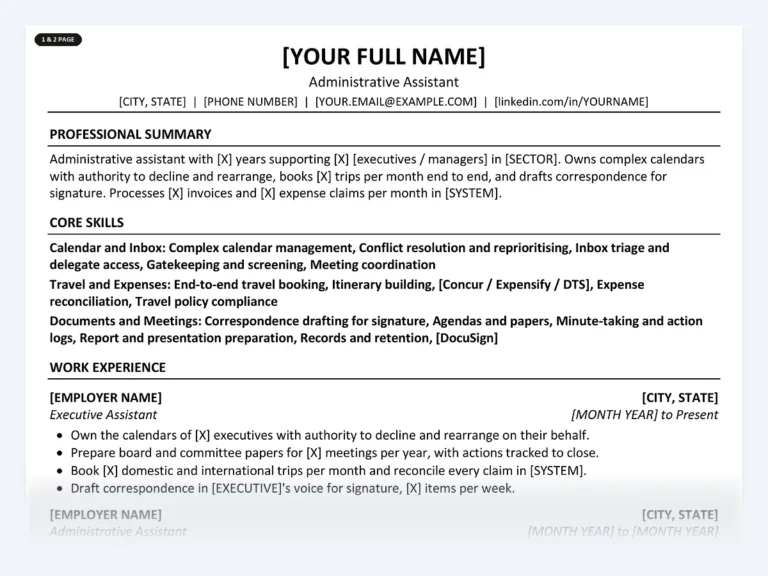
Administrative Assistant Resume Kit
A finished resume and cover letter written for administrative assistant jobs, with brackets where your details go.
The Career Kit also includes a reference request kit: the ask, the briefing, a reference page layout and the thank-you notes.
When references get checked, and how to keep them ready
Reference checks usually come late: after the final interview, and often just before or alongside an offer. That timing matters. If a recruiter asks for your references, you are probably close, so reply the same day with your page attached.
Then tell your referees. A two-line message works: “[Company] may call you this week about the [job title] role. Thank you again.” A referee who knows the call is coming picks up an unknown number.
Thank them twice
Once when they agree, and again when the process ends. If you got the job, tell them where and when you start. If you didn’t, tell them anyway and say you may ask again. People who never hear the outcome stop saying yes.
- Reference page matches your resume header and font
- Three people, strongest first, all asked and all agreed
- Current title and employer for each, with a relationship line
- Phone numbers and emails checked this week
- Each referee has the posting, your resume and your briefing
- Thank-you sent, and the outcome shared when you have it
Then make sure the resume they are backing is ready. Our guides to writing a resume, resume length and resume formats cover the rest.
Common questions
Should I put references on my resume?
No. Keep them on a separate reference page with the same header as your resume, and send it when an employer asks. The only exception is a posting or application form that asks for references with the application, and even then they go on their own page or in the form fields.
Should I write “references available upon request”?
No. Employers assume you will provide references if asked, so the line adds nothing and takes space from your experience. Use that line for a certification or a result, or leave it blank.
How many references should I list?
Three is standard, four at most unless the employer asks for more. Put the strongest first, usually your most recent direct manager, because the first name is often the only one called.
Can I use a coworker as a reference?
Yes, as your second or third reference, especially a senior colleague or team lead who saw your work closely. Lead with a manager if you can, because a supervisor’s view carries more weight with most hiring managers.
What if my old manager has left the company?
They can still be your reference. List their current title and employer, then explain the connection in the relationship line, for example “my direct manager at [Old Company], [2020 to 2023].” Find them on LinkedIn if you have lost touch, and ask before you list them.
Get the resume right before anyone calls your references
Find the kit written for your job title. Every role page shows free sample bullets and keywords before you buy, and the Career Kit includes the full reference request kit.
Find your resume template
Written by
Founder, Disruptive Templates
Umair Sajid runs Disruptive Templates and has spent a decade in digital marketing, most of it looking at how people are found online. The resume templates here come from the same question asked of hiring software instead of search engines: what does the machine actually read?

Server Resume Examples: Covers, Checks and Upselling
Managers read a server resume for section size, covers per shift and how you move the check. Here are bracketed examples for casual, fine dining, banquet and bartender-server jobs.

Security Guard Resume Examples: License, Posts and Incidents
Recruiters at security companies check your guard card before anything else. Here is where it goes, with bullets for each post type, incident report wording and an armed version.

Project Manager Resume Examples: Scope, Budget and Delivery
Lead with your method and credential, give every project a size line, and write bullets about what the plan met in real life. With IT, construction and agile versions.