
Resume writing8 min read
Truck Driver Resume Examples: CDL, Endorsements and Safety Record
A truck driver resume is read like an application form. Here is a sample with every section explained, bullets for OTR, regional and local work, and record wording that matches your MVR.
On this page
Key takeaways
- Your CDL class, state, endorsements and restrictions go in the first lines. Recruiters screen on them before they read anything else.
- Give experience as verifiable months on each equipment type, not “8 years of driving”. That’s how carriers and their insurers count it.
- Write your safety record the way your MVR and PSP report state it. Both are pulled before an interview, and a mismatch costs more than the event.
- Over-the-road, regional and local jobs want different proof. Say which operation you run and which one you want next.
A truck driver resume is read like an application form: license, endorsements, equipment months, record. A recruiter looks for those four things first, and a missing or vague one gives them a reason to move on. Below is a sample truck driver resume with every section explained, bullets for over-the-road, regional and local work, and the wording that matches what your records will show. If you’d rather edit a finished version, our truck driver resume template is laid out exactly this way, with brackets for your details.
Put your CDL, endorsements and restrictions first

The first question on every driving job is whether you can legally take the load. So answer it in the line under your name: license class, the state that issued it, every endorsement, and any restriction.
Write endorsements as the letter and the name. Some applicant systems search for “H” and some for “hazmat”, and you want to match both.
| Endorsement | What it covers | How to write it |
|---|---|---|
| H | Hazardous materials | H (hazardous materials) |
| N | Tank vehicles | N (tank vehicle) |
| X | Tank plus hazmat combination | X (tanker and hazmat) |
| T | Double and triple trailers | T (doubles and triples) |
| P | Passenger vehicles | P (passenger) |
| S | School bus | S (school bus, with P) |
List your restrictions too. Few drivers do, and it’s a mistake. An automatic transmission restriction, an air brake restriction or an intrastate-only restriction changes which jobs you can take, and the recruiter will see it on your license at orientation anyway. Stating it up front costs you only the jobs you couldn’t have done, and it saves you a wasted trip.
Round out the credentials line with your DOT medical card expiry date, a TWIC card if you hold one, and your Entry-Level Driver Training provider if you got your Class A or B in or after February 2022, when FMCSA’s ELDT rule took effect.
Truck driver resume example, section by section
Here is the top of a Class A resume with every detail bracketed. Replace each bracket with what your license and records actually say.
| Section | Sample text |
|---|---|
| Title line | Class A CDL Driver, Over-the-Road |
| Credentials | Class A CDL, [STATE], expires [MONTH YEAR] · Endorsements: [H (hazmat), N (tank)] · Restrictions: [none] · DOT medical valid to [MONTH YEAR] · [TWIC] |
| Summary | Class A driver with [X] verifiable months over the road in [dry van and reefer], [X] miles with [no preventable accidents]. Logs on [Motive] with [no hours-of-service violations] in [X] years. Looking for [regional work with weekly home time]. |
| Equipment | [Dry van]: [X] months · [Reefer]: [X] months · [Flatbed]: [X] months · Transmission: [manual and automated manual] |
| Experience | [CARRIER], [CITY, STATE], [MONTH YEAR] to present, followed by five or six bullets like the ones below |
Notice the last sentence of the summary. Saying what operation you want next is useful to both sides. A recruiter filling a local route doesn’t want to find out at orientation that you were hoping for OTR miles.
Write experience in verifiable months by equipment type
“Eight years of driving” can’t be matched to anything. A posting that asks for two years of flatbed means two years of flatbed months that a previous carrier will confirm, because carriers’ insurers usually set the requirement that way. Break your experience down the same way.
Only claim equipment you ran for a stretch a past carrier will confirm. Recruiters call previous employers before orientation, and months that don’t check out end the conversation.
Your safety record, in the words the record uses

Your record is the strongest thing on a driver’s resume, and it’s the part a carrier checks before they meet you. They pull your motor vehicle record (MVR), your Pre-Employment Screening Program (PSP) report and a Drug and Alcohol Clearinghouse query, and they verify your past carriers. So state your record as a number, in the terms those reports use.
- Drove [X] miles over [X] years with [no preventable accidents].
- Passed [X] roadside inspections clean and earned [X] CVSA decals since [YEAR].
- Kept [no hours-of-service violations] on [Samsara] logs across [X] years, planning each trip so legal parking was found before the clock ran out.
- Wrote every defect found on pre-trip and post-trip into the DVIR, including [a brake issue] that took the truck out of service before dispatch.
Truck driver resume bullets for OTR, regional and local jobs
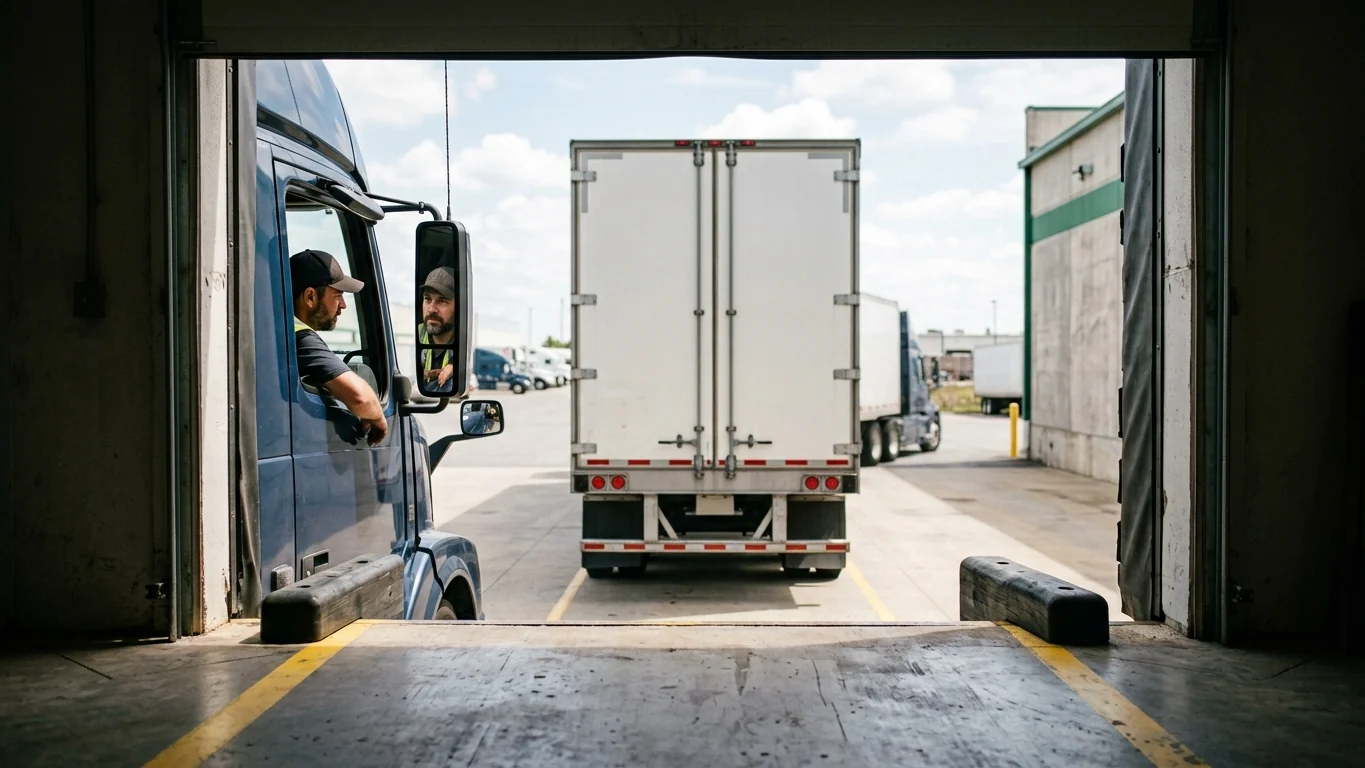
Over-the-road, regional and local are close to three different jobs, with different home time, different skills and different recruiters. Lead with the operation you’ve run, then use bullets that prove the skills that job needs.
Over-the-road (OTR)
OTR recruiters want miles, states and hours-of-service discipline over long runs.
- Ran [X] miles a year across [X] states in [dry van and reefer], out [X] weeks at a time.
- Managed the 11-hour and 14-hour clocks on [ELD] across [X] years with [no violations], shutting down rather than pushing a tired run.
- Held reefer set points at [X]°F for [produce and frozen] loads with [no temperature claims].
Regional and dedicated
Regional work is about repeat customers and a steady on-time record in a set area.
- Delivered [X] loads a week across a [X]-state region at [X]% on time, home [every weekend].
- Ran a dedicated [grocery distribution] account, handling [drop and hook and live unloads] at [X] stores a week.
Local and delivery
Local jobs are won on backing, docks and customers. Plenty of people can drive the interstate; fewer can put a 53-foot trailer into a tight downtown dock at 5 a.m.
- Made [X] stops a day in [metro area] with [a straight truck / day cab], backing into [alley and street-level docks].
- Handled [bills of lading and proof-of-delivery scans] on [X] stops a day with [no paperwork holds] at the receiver.
For more on building bullets around a result, see our guide to resume bullet points.
Choosing and bracketing a dozen of these for your own equipment, operation and years is the slow part, especially when you’re writing from a truck stop.
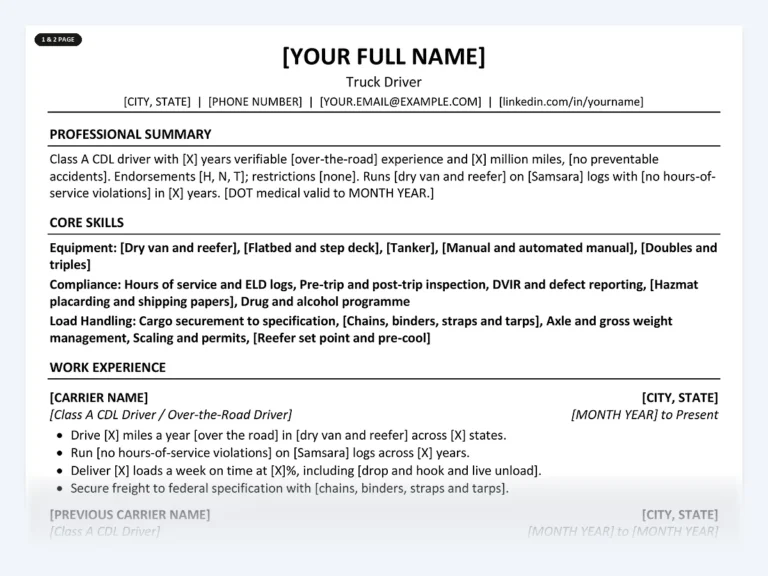
Truck Driver Resume Kit
Already written around license, endorsements, restrictions, equipment months and a checkable safety record. Replace the brackets with what your MVR and license show.
Prefer to start free? The kit page shows sample bullets and keywords before you pay anything, so you can compare it with other resume templates for truck drivers. Moving between trucking and passenger work? There are separate kits for CDL truck drivers choosing an operation type and for bus drivers, where some employers offer paid CDL B training.
How long a truck driver resume should be
One page covers most drivers. Go to two only if you have several carriers across a long career and the equipment months need the room. Our guide on how long a resume should be explains the tradeoff.
Don’t confuse the resume with the carrier’s driver application. Federal rules (49 CFR 391.21) have the application cover every employer for the last three years plus any commercial driving jobs going back a further seven. Fill that form in completely, gaps explained, even if your resume shows less. Carriers process the form.
Leave these off
- Endorsements that aren’t on your license, or equipment you haven’t run for a verifiable stretch.
- Customer names, lanes and load details your carrier treats as confidential. Describe the freight type instead.
- Photos or video taken from behind the wheel, in any form.
- Complaints about a past dispatcher or carrier. Recruiters move between companies.
- A single “years of experience” number with no equipment breakdown.
New to writing a resume at all? Start with how to write a resume, then come back for the driving-specific parts. When a carrier calls you in, have your own questions ready about home time and equipment; our guide to questions to ask an interviewer covers the rest.
Common questions
What should a truck driver put at the top of a resume?
Your license class and state, endorsements by letter and name, any restrictions, and your DOT medical expiry, all in the line under your name. Then a two- or three-line summary with your verifiable months, equipment types, miles and safety record, and the operation you want next.
Should I put restrictions on my truck driver resume?
Yes. An automatic transmission, air brake or intrastate-only restriction changes what you can be hired for, and it will be seen at orientation. Stating it up front filters out jobs you couldn’t take anyway. If you plan to test out of a restriction, say that too.
How do I write a truck driver resume with no experience?
Lead with your new CDL, your ELDT provider and your skills test, then your training hours with a trainer if you’ve started. Add any job that shows reliability and safety habits, such as warehouse, forklift or delivery work, and state the operation you’re aiming for. Many carriers hire recent graduates into a trainer program.
What skills go on a truck driver resume?
Equipment types, cargo securement, pre-trip and post-trip inspection, hours-of-service and ELD logging, trip planning, backing and docking, and weight and axle management. Name your ELD or fleet system (Samsara, Motive, Omnitracs) as a product, since a fleet running it would rather not retrain you.
Do I need a resume if the carrier has its own application?
Often the application is what gets processed, so fill in every field. A resume still helps when a recruiter calls, when you apply through a job board, and when you want to show equipment months and a safety record in one clean page.
Start from a truck driver resume that’s already written
The truck driver kit has the credentials line, equipment months and record bullets in place for OTR, regional and local work. Replace the brackets, check it against your MVR, and send it.
See the truck driver kit
Written by
Founder, Disruptive Templates
Umair Sajid runs Disruptive Templates and has spent a decade in digital marketing, most of it looking at how people are found online. The resume templates here come from the same question asked of hiring software instead of search engines: what does the machine actually read?

Accountant Resume Examples: Entry Level to CPA
A controller wants three answers from your accountant resume: CPA status, the ERP you've closed the books in, and what you own. Here are examples that give them, from a…

Server Resume Examples: Covers, Checks and Upselling
Managers read a server resume for section size, covers per shift and how you move the check. Here are bracketed examples for casual, fine dining, banquet and bartender-server jobs.

Security Guard Resume Examples: License, Posts and Incidents
Recruiters at security companies check your guard card before anything else. Here is where it goes, with bullets for each post type, incident report wording and an armed version.