
Resume writing9 min read
Customer Service Skills for a Resume (With Bullet Examples)
A skills list with no proof behind it gets skimmed. Here are the customer service skills for a resume that postings ask for, each with a bullet that proves it, split by phone, chat and in-store work.

On this page
Key takeaways
- Take the customer service skills for your resume from the posting itself, then prove each one in a bullet. A skills list with no proof behind it gets skimmed past.
- The hard skills that get searched are systems and metrics: Zendesk, Salesforce, Five9 or your POS, plus first contact resolution, handle time, CSAT and quality score.
- Give your numbers in pairs. Handle time on its own reads as rushing customers off the line; pair it with first contact resolution.
- Phone, chat and in-store service are different skill sets. Say which channels you worked and write bullets for each.
Every customer service resume says “excellent communication skills”, and hiring managers read past it because it proves nothing. The skills that get you a call are specific: the systems you’ve used, the channels you’ve worked, and numbers that show you fixed problems rather than just answered them.
Below are the customer service skills for a resume that postings ask for, each with a bracketed bullet you can adapt, split by phone, chat and in-store work. If you want a finished draft to work from, our customer service representative resume template is built this way.
Customer service skills for a resume: what employers search for

Recruiters filter on hard skills, because hard skills are words a system can search for. Soft skills matter just as much in the job, but they only persuade anyone once a bullet shows them in action. Here is what postings and screeners keep coming back to, and how each one shows up on a strong resume.
| Skill | Type | How it shows on the page |
|---|---|---|
| Ticketing and CRM systems (Zendesk, Freshdesk, Salesforce, Dynamics 365) | Hard | Named as products in your skills section and in at least one bullet |
| Contact center telephony (Five9, Genesys, NICE) | Hard | Named, with inbound, outbound or blended |
| Point of sale (NCR, Square, Clover, your chain’s system) | Hard | Named, with the payment types you handle |
| First contact resolution, handle time, CSAT, quality score | Hard | Your own figures, given in pairs |
| Schedule adherence | Hard | A percentage over a stated period |
| Billing, refunds and returns | Hard | What you could credit or refund without approval |
| De-escalation and complaint handling | Soft, provable | Complaints taken to a documented outcome |
| Written tone on chat and email | Soft, provable | Concurrent chats handled and the quality score on them |
| A second language | Hard | The language and your level, near the top of the page |
Notice what’s missing: “people person”, “team player”, “fast learner”. Those are claims every applicant makes. Leave them in the interview, where you can back them up with a story.
Customer service soft skills only count when a bullet proves them
A soft skill in a skills list is an adjective. The same skill inside a bullet, with a number and a setting, is evidence. The fix is mechanical: take the soft skill, ask what you did that shows it, and write that instead.
Here’s how the common soft skills translate:
- Empathy becomes a quality score on recorded calls, because those calls are graded against a rubric by someone listening for exactly that.
- Communication becomes documentation: notes another agent can pick up without calling the customer back.
- Judgment becomes authority. What could you credit, waive or refund without asking a supervisor? Almost no resume states it, and it’s the clearest sign of seniority in this work.
- Reliability becomes adherence, the percentage of your scheduled time you were actually logged in and available.
For more rewrites like these, see our guide to resume bullet points.
Customer service skills by channel: phone, chat and in store

A hiring manager for a chat team and a store manager hiring for the front end are looking for different things, even when the posting says “customer service” for both. Say which channels you’ve worked, then give each one its own proof. The customer service resume examples below follow that split.
Phone and contact center
The phone skills that matter are routing, documentation and working to a schedule. Contact centers plan staffing to the half hour, so a supervisor reads adherence before almost anything else. On regulated lines (healthcare, insurance, banking), knowing when to escalate instead of improvising a helpful answer is a skill in its own right.
- Handled [X] inbound calls a day on [Five9 / Genesys] in [VERTICAL], with schedule adherence of [X]% over [X] months.
- Escalated [policy exceptions] to [a supervisor] instead of improvising, and documented every call so the next agent could pick it up cold.
Remote work is now common here. When we reviewed twenty call center postings on a single day for our call center representative kit, fifteen were remote, and one asked applicants to supply their own equipment and internet connection. If you work from home, state your setup as a skill: a machine that meets the spec, a backup connection, no dropped shifts.
Chat and email
Chat is its own skill because you’re reading tone without a voice, often in two or three conversations at once. Say how many you ran concurrently. For email, the measure is backlog and response time.
- Ran [X] live chats concurrently in [Zendesk / Intercom] while holding a quality score of [X]% on chat transcripts.
- Cleared an email backlog of [X] tickets to under [X] hours’ response time using [macros] rewritten for [the top X contact reasons].
In store: cashier and sales floor
Face-to-face service is about exceptions and the sale. For a cashier, scanning is the part self-checkout now does; what a person is still hired for is the return without a receipt, the coupon the system rejects, and refusing an age-restricted sale correctly while a line watches. For a sales associate, it’s the selling: Home Depot’s own posting describes the method as greet, qualify, recommend and close.
- Balanced the till with [no variance] for [X] consecutive months while supervising [X] self-checkout lanes.
- Converted [X]% of the customers I approached in [DEPARTMENT] and attached [accessories or protection plans] to [X]% of sales.
Put your customer service numbers in pairs

Two of the core measures in this job pull against each other. Average handle time pays you for a short contact. First contact resolution and satisfaction pay you for staying with the customer until the problem is gone. Anyone who has run a contact center knows this, so a resume that shows only one number tells them something you didn’t intend.
- Handle time alone reads as someone who clears the queue.
- CSAT alone reads as someone who takes forever.
- Both together read as someone who understands the trade:
Then add the two that almost nobody includes: schedule adherence and your resolution authority. “Credited or waived up to [$X] without approval” is a single line, it’s checkable, and it tells a hiring manager how much the last employer trusted you.
Writing twelve of these bullets from scratch, for your channel and your experience level, is the slow part. That’s the part a written kit does for you.
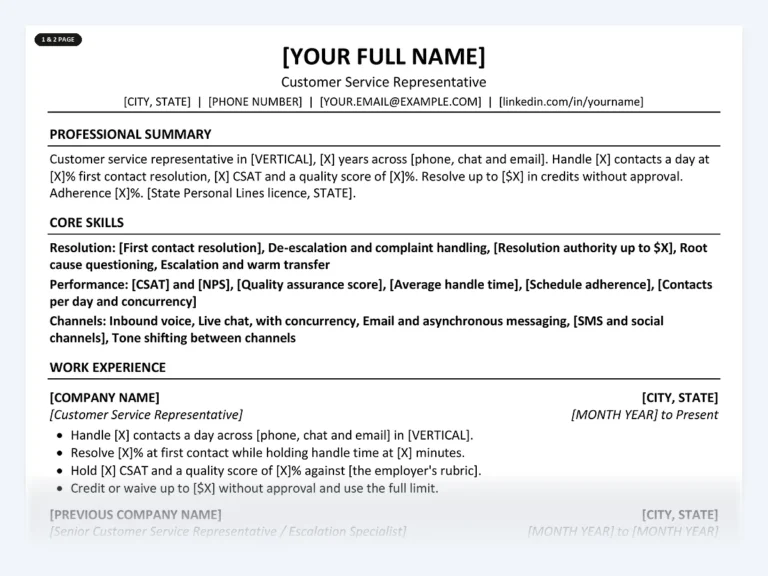
Customer Service Representative Resume Kit
Written around paired metrics, resolution authority and the channels you worked. The Career Kit adds 48 bullets across four experience levels and a keyword bank in seven groups.
Prefer to start free? The role page shows sample bullets and keywords you can use today.
Where each skill goes on your resume
Skills belong in three places, and each has a job.
- The summary names your vertical, channels and two numbers. Insurance, healthcare, retail and banking customer service share a title and run on different rules, so the recruiter needs to see yours first. If you hold a state insurance license (Personal Lines, or Property and Casualty), it goes here too.
- The skills section is grouped, not a wall of words. Resolution, performance, channels, systems, then your vertical. Leading with systems makes you look like a Zendesk user rather than someone who fixes problems.
- The bullets carry the proof. Every skill in the list should appear, with a number, in at least one bullet.
Mirror the posting’s job title too. Customer service representative, customer care specialist and contact center agent are searched separately, even when the work is the same. Our guide to pulling keywords from a job description shows how to find the exact terms, and tailoring your resume to the job covers rewriting the top third for each application.
Leave these off
- Customer names, account numbers or details of a specific complaint. They’re confidential, and in regulated lines disclosing them can be a reportable breach.
- Duty lists every agent performs: answering phones, responding to emails, using a computer.
- Handle time with no resolution figure beside it.
- Complaints about customers or about how you were scored.
- Your employer’s internal queue statistics or service levels.
Common questions
What are the top skills for a customer service resume?
The ones in the posting you’re applying to, proven in bullets. Most postings name a ticketing or CRM system, a phone or POS system, de-escalation, and metrics such as first contact resolution, handle time and CSAT. A second language is worth stating near the top in any public-facing role.
Should soft skills go in the skills section?
Only if the posting names them, and even then prove them in a bullet. “De-escalation” is fine in a skills list if a bullet shows complaints you took to a resolution. “Great attitude” adds nothing on paper; save it for the interview.
How many skills should I list?
Enough to cover what the posting asks for, grouped into four or five short groups. Ten to fifteen real skills beat thirty where half are filler, because a recruiter who spots one padded item starts doubting the rest.
What if I have no customer service experience?
Use what you’ve done that looks like the job: a register at a summer job, a front desk, volunteering where you dealt with the public, a school role handling questions. Name the setting and the scale, such as customers a shift or calls a day, and put your availability and any second language high on the page.
Is customer service the same as customer success?
No. Customer service is reactive: contacts arrive in a queue and you’re measured on resolution, handle time and satisfaction. Customer success owns named accounts through onboarding and renewal and is measured on retention. If you’re moving from one to the other, the queue metrics come off the page.
Start from a customer service resume that’s already written
The customer service representative kit has the paired metrics, channel bullets and keyword groups in place. Replace the brackets with your numbers and it’s ready to send.
See the customer service kit
Written by
Founder, Disruptive Templates
Umair Sajid runs Disruptive Templates and has spent a decade in digital marketing, most of it looking at how people are found online. The resume templates here come from the same question asked of hiring software instead of search engines: what does the machine actually read?

Server Resume Examples: Covers, Checks and Upselling
Managers read a server resume for section size, covers per shift and how you move the check. Here are bracketed examples for casual, fine dining, banquet and bartender-server jobs.

Security Guard Resume Examples: License, Posts and Incidents
Recruiters at security companies check your guard card before anything else. Here is where it goes, with bullets for each post type, incident report wording and an armed version.

Project Manager Resume Examples: Scope, Budget and Delivery
Lead with your method and credential, give every project a size line, and write bullets about what the plan met in real life. With IT, construction and agile versions.