
Resume writing8 min read
Data Analyst Resume Examples: Tools, Projects and Bullets
Examples you can adapt for every part of a data analyst resume: the tools line, bullets with one business outcome each, and projects for entry-level and career-change applicants.

On this page
Key takeaways
- Put SQL and one named BI tool, such as Tableau or Power BI, in the top third of your data analyst resume. Most postings name both, so put them where a quick skim finds them.
- Show SQL depth with the words that signal it: joins, window functions, CTEs, query tuning.
- Give every bullet one business outcome: a dashboard people use, a report retired, a number reconciled, a decision made.
- No analyst job yet? Two or three projects that each answer a real question beat a long list of tools.
- Entry-level resumes prove judgment; experienced ones prove ownership of metrics and of other people’s work.
A strong data analyst resume names the tools the posting screens for, then proves each one with a result someone else relied on. Most samples of a resume for a data analyst stop at a skills list and a few “analyzed data to drive insights” bullets.
Below are examples you can adapt: a tools line, bullets with one outcome each, project entries for career changers, and what changes between entry level and senior. If you’d rather start from a finished draft, the data analyst resume template has this structure written out.
What a data analyst resume has to prove

A data analyst resume has to prove you can turn a vague business question into a number other people trust. That breaks into four things a hiring manager looks for, roughly in this order:
- SQL you wrote yourself, against a warehouse or database someone else built.
- A named BI tool, and dashboards that people outside your team open without you.
- Data quality work: cleaning, deduplicating and reconciling a result against the figure the business already believes.
- Communication: presenting a finding to someone who wants a decision, not a methodology.
Job titles blur here, so read the duties, not only the title. One Veterans Health Administration announcement we studied was titled Data Scientist, yet its first duty line puts the hire to work “as a Data Analyst”, and it names SQL, R, SAS, SPSS and STATA for pulling datasets from the VA’s data warehouse (USAJOBS). Search under data analyst, BI analyst and reporting analyst, and mirror whichever title each posting uses.
The tools line: SQL first, then your BI tool
Lead your skills section with SQL and the BI tool, because reporting-role postings usually list those two before anything else. Then show depth in the same line, since everyone writes “SQL” and only some mean it. Here is a sample skills section, grouped the way the work divides:
- SQL: joins, window functions, CTEs, query tuning, [Snowflake / BigQuery / SQL Server]
- BI and reporting: [Power BI / Tableau / Looker], dashboard design, row-level security, scheduled refresh
- Analysis: exploratory analysis, A/B test read-outs, cohort and funnel analysis
- Data quality: cleaning and deduplication, reconciliation to source systems, metric definitions
- Also: advanced Excel (Power Query, XLOOKUP), [Python / R] for cleaning, Git
Name products, not categories. “Power BI” matches a search; “data visualization software” does not. Keep Python or R only if you could answer questions about your own code, since many reporting jobs don’t require either and a technical screen will test what you list. For how to lift the exact terms from a posting, see resume keywords from a job description.
Data analyst resume bullets: one business outcome each

Write each bullet as tool, action and what changed for someone else. “Changed for someone else” is the part most analysts leave out. A query is not an outcome; the report it replaced, the meeting it shortened or the decision it settled is.
That third one matters more than it looks. Agreeing what a metric means, which table is the source of truth and why two reports disagree is most of the job, and hiring managers know it. Few resumes say so.
Three rules keep bullets honest:
- Don’t invent revenue or savings. If you can’t trace a figure to a decision, describe the decision instead.
- Count users, reports, sources and hours, which you can usually verify.
- Name the audience: “for the [CFO’s] monthly pack” tells a reader the work mattered.
More patterns are in our guide to resume bullet points.
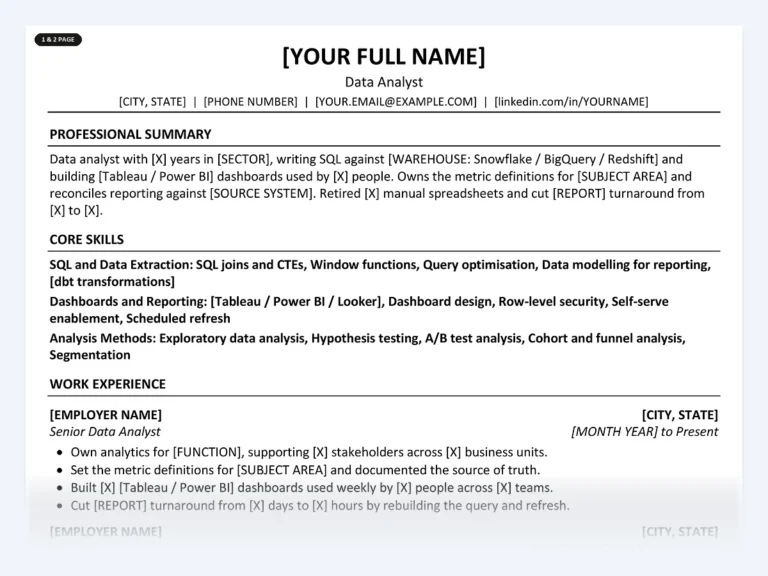
Data Analyst Resume Kit
Writing a dozen bullets like these for your own level is the slow part. The Career Kit adds a bullet library of 48 data analyst bullets in four experience bands, plus a keyword bank with the tools and titles postings screen for.
Sample data analyst resume, section by section
Here is how a mid-level data analyst resume fits together on one page. Swap every bracket for your own details.
| Section | What goes in it | Example |
|---|---|---|
| Title line | The posting’s job title and your BI tool | Data Analyst, [Power BI] |
| Summary | Years, sector, warehouse, BI tool, one result | Data analyst with [3] years in [e-commerce], querying [BigQuery] and building [Power BI] reports for [5] teams. Owns the [retention] metric definitions. Replaced [9] manual spreadsheets with scheduled reports. |
| Skills | SQL depth, BI tool, analysis, data quality | The grouped tools line above |
| Experience | 4 to 6 bullets per recent job, one outcome each | The rewritten bullets above |
| Projects | Only if they add something your jobs don’t show | [Public dataset] analysis with the question it answered and a link |
| Education and certifications | Degree or route; certifications you actually hold | [Microsoft Certified: Power BI Data Analyst Associate], [year] |
Certifications are optional in this field, and there is no license. List one only if you hold it and use that vendor’s tool. Common ones include the Microsoft Certified: Power BI Data Analyst Associate, Tableau Certified Data Analyst and the Google Data Analytics Professional Certificate. Vendors rename these, so copy the current name from the vendor’s own site.
Entry level and career changers: projects in place of history

With no analyst job yet, your projects carry the resume, and each one has to prove judgment, not just that you finished a tutorial. The common failure is a technically fine notebook with no decision at the end of it. Give every project four parts:
- The question. “Which [bike share] stations run empty before 8 a.m.?” beats “Exploratory analysis of bike data”.
- Why this method. One line on why you chose the chart or test you did.
- The decision. What someone should do differently because of your answer.
- What you’d change. One honest line. A mistake you caught and corrected is more convincing than a perfect project.
Career changers have a second asset: the job you’re leaving. If you kept the spreadsheet your team relied on, reconciled stock counts or built a weekly report in Excel, that is analyst work with a real audience. Lead with it, and put your target title in the resume’s title line while keeping your official job titles accurate in the work history. Our career change resume guide covers the layout, and the entry-level data analyst kit is written around projects rather than history.
Entry level vs experienced data analyst resumes
The skills stay similar across levels; what changes is scope and ownership. First analyst jobs are mostly about maintaining what already exists. O*NET’s task list for business intelligence analysts puts generating standard reports and maintaining existing dashboards at the top (O*NET 15-2051.01).
| Level | Typical work | What the bullets should show |
|---|---|---|
| About 1 year | Tickets from a request queue, updates to existing dashboards, reviewed SQL | Volume, accuracy, data issues you found and escalated |
| About 3 years | Owns a subject area, turns vague requests into specs, builds dashboards from scratch | Metric definitions owned, reports retired, stakeholders served |
| 7+ years | Owns analytics for a function, reviews other analysts’ work, sets definitions | People mentored, work reviewed, requests refused or rescoped, data engineering priorities set |
Neighboring titles need different evidence too. A healthcare data analyst leads with claims, eligibility and clinical feeds, the standards handled (FHIR, HL7, X12) and how small groups were suppressed so no patient could be identified. A business analyst leads with requirements, user stories, acceptance criteria and process maps, and may never write SQL. If your work is split, pick the title the posting uses and let its vocabulary lead.
Common questions
Do I need a degree to get a data analyst job?
It depends on the employer. Federal postings often require a degree in mathematics, statistics, computer science or a related field, or equivalent coursework. Many private employers hire on demonstrated SQL and BI work instead; without a relevant degree, put projects and certifications where the degree would go.
How do I show SQL skills without a code sample?
Use the words that signal depth and tie them to a result: “used window functions and CTEs to build a running retention calculation” or “cut a query from 12 minutes to 40 seconds”. A GitHub link with a few clean queries helps if the repository is tidy and current.
Should a data analyst resume include a portfolio link?
Yes, especially at entry level. Put it in the contact line, and make sure each project states the question it answers. A broken or empty link is worse than none.
Should a data analyst resume be one page?
One page suits most analysts with under about ten years of experience. Senior analysts and analytics managers with several owned functions can use two, as long as the recent work fills them.
Which certifications are worth listing?
Only ones you hold, from vendors whose tools you use: for example Microsoft’s Power BI Data Analyst Associate, Tableau Certified Data Analyst or the Google Data Analytics Professional Certificate. None is required for the role, so they support your evidence rather than replace it.
Start from a data analyst resume that’s already written
The data analyst page has free sample bullets and keywords to read first. The kit gives you 1-page and 2-page Word versions with SQL, BI and reconciliation bullets already in place, and brackets for your own tools and numbers.
See the data analyst kit
Written by
Founder, Disruptive Templates
Umair Sajid runs Disruptive Templates and has spent a decade in digital marketing, most of it looking at how people are found online. The resume templates here come from the same question asked of hiring software instead of search engines: what does the machine actually read?

Server Resume Examples: Covers, Checks and Upselling
Managers read a server resume for section size, covers per shift and how you move the check. Here are bracketed examples for casual, fine dining, banquet and bartender-server jobs.

Security Guard Resume Examples: License, Posts and Incidents
Recruiters at security companies check your guard card before anything else. Here is where it goes, with bullets for each post type, incident report wording and an armed version.

Project Manager Resume Examples: Scope, Budget and Delivery
Lead with your method and credential, give every project a size line, and write bullets about what the plan met in real life. With IT, construction and agile versions.