
Resume writing9 min read
Engineering Resume Templates: Civil, Electrical, Mechanical and More
Pick the engineering resume template for your discipline, then get the parts every engineering resume shares right: the discipline line, FE and PE placement, and project bullets with real scope.

On this page
Key takeaways
- On any engineering resume template, say which engineer you are in the first line. “Engineer” alone tells a recruiter nothing; “civil engineer, water resources, EIT” tells them almost everything.
- Put licensure where screeners look: PE after your name, and FE, EIT or PE status with state and date in a licenses section near the top.
- Give every project a size and say what your part was. “Designed [a pump station] for [a $3.4M] upgrade” beats “worked on design projects”.
- Entry-level engineers should show the piece of work they owned and finished, not only the degree and GPA the screen already used.
- Use a plain single-column layout. Tables and text boxes are what commonly break parsing.
An engineering resume template has to do one thing a generic template can’t: show your discipline, your licensure status and the size of the work you have done, in the first few lines. Below are resume templates for engineers in each discipline, then how to write the parts every engineering resume shares: the discipline line, FE and PE placement, and project bullets with scope and budget. Each template is a Word file already written for that job, with brackets where your details go.
| Job title | Industry | What the kit leads with |
|---|---|---|
| Civil engineer | Infrastructure, public works, consulting | PE status, stated design assumptions, field decisions when ground conditions differ |
| Electrical engineer | Power, controls, building services, electronics | Which electrical engineer you are, FE or PE status, designs changed during the build |
| Entry-level mechanical engineer | Manufacturing, energy, automotive | Failure investigations, CAD models others can use, the FE date |
| Project engineer | Construction, manufacturing, energy | RFI and submittal turnaround, shop drawing review, field conditions resolved |
| Entry-level engineer | Any discipline, first job | Assigned work handed back finished, write-ups seniors used without redoing |
| Environmental engineer | Compliance, remediation, government | Permits and regulators, contaminated sites, the record as the deliverable |
| Design engineer | Product development, manufacturing | Drawing release, supplier-ready documentation, change cost after tooling |
| Manufacturing engineer | Production plants | Variation on the line, process ownership, cost per part |
| Process engineer | Chemical, food, pharma, continuous plants | Operating windows, process hazard analysis, changes made while running |
| Industrial engineer | Operations, logistics, manufacturing | Measured processes, Lean or Six Sigma work, what was actually implemented |
| Quality engineer | Manufacturing, medical devices, aerospace | The right to stop, prevention, supplier quality |
| Aerospace engineer | Aircraft, space, defense | Certification basis, means of compliance, margin against weight |
| Biomedical engineer | Hospitals, clinical engineering, devices | Devices in clinical use, recalls, networked device security |
| Engineering manager | Any engineering function | Team output, budget, the technical judgement you still owe |
Lead your engineering resume with your discipline

“Engineer” covers jobs that share almost nothing. A recruiter filling a water resources role and one filling a controls role both search for engineers, then filter hard on discipline and licensure. Your title line and summary should answer both before anything else.
Electrical engineering shows the problem clearly. The Bureau of Labor Statistics itself splits the occupation into electrical engineers, who design systems such as motors and power generation equipment, and electronics engineers, who design components and circuitry. In practice the market splits further: power distribution, building services, controls, embedded hardware, test and utilities. None of that can be inferred from “Electrical Engineer” alone, so name it.
The “after” does the screen’s work for it: discipline, sector, years, license, tools and one piece of proof. Use your own details in every bracket, and name software exactly as postings name it, such as AutoCAD Civil 3D, SolidWorks or MATLAB, rather than “CAD tools”.
Where to put FE, EIT and PE on an engineering resume

Licensure is often the first filter, so it goes near the top, not on page two. The usual US sequence, as the Bureau of Labor Statistics describes it: an engineering degree, then the Fundamentals of Engineering (FE) exam, which makes you an engineer in training (EIT) or engineer intern (EI). After typically four years of experience comes the Principles and Practice of Engineering (PE) exam. Each state issues its own license.
How much it matters depends on the job. Licensure is generally required for engineers who provide services directly to the public, and some employers demand it at application. One US Army Corps of Engineers geotechnical posting required applicants to hold a PE and submit proof with the application. Many manufacturing and product roles never ask for one.
| Your status | How to write it | Where it goes |
|---|---|---|
| Licensed PE | Professional Engineer (PE), [Civil], [State], License #[number] | After your name (“[Name], PE”) and first in the licenses section |
| Passed FE | Engineer in Training (EIT), [State], FE passed [Month Year] | Licenses section, and in your summary for entry-level roles |
| FE booked | FE exam scheduled, [Month Year] | Licenses section, only with a real date |
| Not pursuing licensure | Leave the line out | Nowhere. Don’t explain an absence nobody asked about |
Put the licenses section directly under your summary, above experience. Add certifications that matter in your field in the same section, for example Lean or Six Sigma training for industrial engineers, or PMP for project engineers who run delivery.
Engineering project bullets with scope and budget
Most engineering resumes list what the project was and leave out what the engineer did. A strong project bullet answers four questions: what was built or fixed, how big it was, what part was yours, and what happened because of your work.
Size can be money, length, capacity, load or people. Use whichever your discipline counts in, and only a figure you can defend in an interview. If your employer treats contract values as confidential, use a range or a physical measure instead. Here is what that looks like across disciplines:
- Civil: Documented design assumptions for [a levee seepage reassessment] and made the field call on [changed soil conditions] during construction, recorded the same day.
- Electrical: Revised [a switchgear layout] after [the installing contractor] flagged [a clearance conflict], avoiding [a change order] before energization.
- Mechanical: Led the failure investigation on [a recurring pump seal failure]; the root cause and fix were adopted across [4] sites.
- Project engineer: Turned around [RFIs and submittals] in [3] days on average across [a $22M] build, and reviewed shop drawings for [structural steel] against the specifications.
Notice the verbs. Each one says what your part was. “Assisted with” and “worked on” hide it. For more on the pattern, see our guide to resume bullet points.
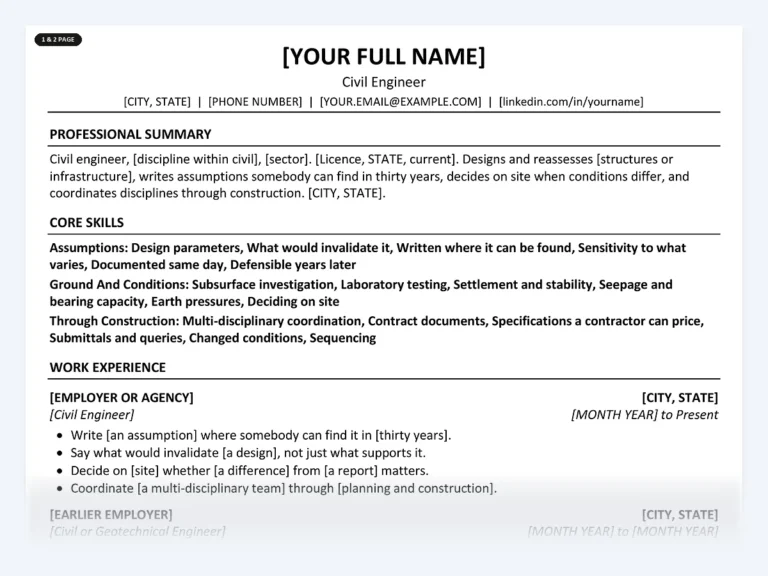
Civil Engineer Resume Kit
A finished civil engineer resume with the license line and project bullets written, in 1-page and 2-page versions.
You replace the brackets with your own projects and PE status.
Entry-level engineering resumes: show the piece you finished

A graduate’s first resume for engineering jobs usually leads with the degree, the GPA, coursework and a capstone. That is exactly the information the screen has already used. The question the hiring engineer is actually asking is different: if they hand you a small piece of a larger problem, will it come back finished and usable, or will they have to redo it?
Federal postings say this plainly. Mechanical engineering announcements in the GS-0830 series describe a GS-07 engineer as an advanced entry-level trainee doing minor phases of a higher-grade engineer’s assignment. So write the piece, not the whole project:
- Wrote up [a tolerance stack-up] for [a senior engineer]; it went into [the customer design review] without rework.
- Owned [the thermal analysis] on [a 5-person capstone]; flagged [a heat sink sizing error] in week [2] rather than at final review.
- Took the failure investigation on [a cracked mounting bracket] during a [summer internship]; the recommended [material change] was released.
Mechanical graduates have one more thing worth showing: learning which numbers on a drawing are real. A bullet about finding that a tolerance was copied from an old drawing, and checking with the machinist before changing it, shows judgement no GPA can.
Screens that entry-level engineers should state plainly
Put the facts screeners filter on where they can find them: the degree with accreditation (ABET for US programs), the graduation date, FE status, and work authorization or citizenship when the posting requires it. Include GPA when a posting sets a minimum. One Air Force General Engineer posting set it at 2.95. Recent-graduate programs have windows too: a Bureau of Reclamation recent-graduate mechanical engineer posting was open to people within two years of graduating, or six for veterans. Check each program’s own terms.
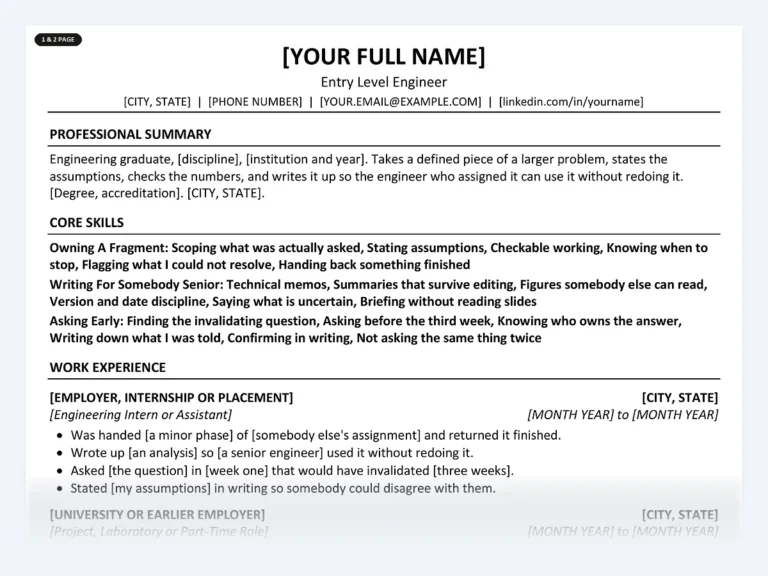
Entry-Level Engineer Resume Kit
A first engineering resume built around work you finished and handed back, with the degree and FE status placed where recruiters look.
Engineering resume template layout and length
Engineering resumes are dense with credentials, software and numbers, which makes a clean layout matter more, not less. Keep to one column, standard headings (Summary, Licenses and Certifications, Experience, Projects, Education, Skills) and no tables, text boxes or skill graphics. Those are what commonly break parsing. Our ATS-friendly resume format guide shows the safe version. If you typeset yours in LaTeX, run the two-minute copy test from our LaTeX vs Word resume guide before you send it.
One page works for graduates and most engineers with under five years. Two pages are normal once you have licensed work, several major projects or people to manage. See how long a resume should be for the full rule. Whatever the length, the discipline line and licenses section stay in the top third of page one.
- Discipline and years of experience in the first line
- PE after your name if you hold it, with state
- Licenses section under the summary: FE, EIT or PE with state and date
- Every project bullet has a size and says what your part was
- Software named exactly as postings name it, with the rest of your resume skills grouped by type
- No numbers you couldn’t explain in an interview
Common questions
Should I put EIT on my resume?
Yes, if you passed the FE exam. Write “Engineer in Training (EIT), [State], FE passed [Month Year]” in a licenses section near the top, and mention it in your summary for entry-level roles. Some states use “Engineer Intern (EI)” instead, so use your state’s term.
How do I list a PE license on a resume?
Add “PE” after your name in the header, then list the license in full under your summary: Professional Engineer, discipline, state and license number. Include every state where you are licensed.
Should an engineering resume include a projects section?
For students and graduates, yes, with your part of each project stated. For experienced engineers, projects usually sit inside each job as bullets with scope and budget. A separate section makes sense only for licensed engineers who list major projects across several employers.
Can I include project budgets if they are confidential?
Don’t publish figures your employer treats as confidential. Use a range, a public contract value, or a physical measure such as miles, megawatts or square feet. The point is to show size, and there is usually more than one way to do it.
Which resume template is best for engineers?
A plain, single-column template with standard headings, written for your discipline. Design-heavy templates with columns and graphics look good but often parse badly, and they leave less room for the licenses and project detail engineering recruiters look for.
Find the engineering resume template for your discipline
Every engineering kit is written for its job title, with the license line and project bullets in place. Edit the Word file, replace the brackets, and see the free sample bullets on each role page first.
Browse all resume templates
Written by
Founder, Disruptive Templates
Umair Sajid runs Disruptive Templates and has spent a decade in digital marketing, most of it looking at how people are found online. The resume templates here come from the same question asked of hiring software instead of search engines: what does the machine actually read?

Server Resume Examples: Covers, Checks and Upselling
Managers read a server resume for section size, covers per shift and how you move the check. Here are bracketed examples for casual, fine dining, banquet and bartender-server jobs.

Security Guard Resume Examples: License, Posts and Incidents
Recruiters at security companies check your guard card before anything else. Here is where it goes, with bullets for each post type, incident report wording and an armed version.

Project Manager Resume Examples: Scope, Budget and Delivery
Lead with your method and credential, give every project a size line, and write bullets about what the plan met in real life. With IT, construction and agile versions.