
Resume writing8 min read
Accountant Resume Examples: Entry Level to CPA
A controller wants three answers from your accountant resume: CPA status, the ERP you've closed the books in, and what you own. Here are examples that give them, from a first seat to senior.

On this page
Key takeaways
- State your CPA status exactly: licensed with the state, or candidate with the sections passed and dates. Never let “candidate” read as “licensed”.
- Name your systems as products (QuickBooks Online, NetSuite, SAP, Sage Intacct). “Accounting software” matches no search.
- Build bullets on the ledger: reconciliations owned, journal entries per close, days to close, audit adjustments.
- Entry level, staff and senior resumes prove different things. Write for the seat you’re applying to, not the one you want in five years.
Most accountant resumes use words that fit any finance job: “detail-oriented”, “proficient in accounting software”. A controller hiring for the close wants three answers instead: your CPA status, the ERP you’ve closed the books in, and how many reconciliations you own. Below are examples that answer them, from a first seat out of school to the person who signs off the close. Our accountant resume template follows the same structure if you want a finished draft.
Write your CPA status exactly as it stands

CPA status is often a hard filter, so it goes in the header line or right under it. It’s also the easiest claim on the page to check: state boards publish license lookups, and NASBA runs a national one, CPAverify, so a recruiter can verify it in seconds. There are three honest ways to write it.
| Your status | How to write it |
|---|---|
| Licensed | Certified Public Accountant (CPA), [STATE] Board of Accountancy, [YEAR] |
| Sitting the exam | CPA candidate: [AUD, FAR] passed [MONTH YEAR]; [REG] scheduled [MONTH YEAR] |
| Still in school or credits short | [X] of [150] credit hours completed; [X] CPA exam sections passed |
Don’t put “CPA” after your name until you hold the license, and avoid “CPA eligible” if it could be read as licensed. Spell out Certified Public Accountant once, with the abbreviation, because some systems search for the words and some for the letters.
Licensing requirements are set state by state. Most boards have long required 150 credit hours, and several now also offer a route with 120 hours plus two years of supervised experience, per NASBA’s summary of the new pathways. Check your own board and state your hours in its terms.
Other credentials go in the same line, each with its issuer: Certified Management Accountant (CMA) from the IMA, Certified Internal Auditor (CIA) from the IIA, Enrolled Agent (EA). They’re different credentials, so don’t let one stand in for another.
Accountant resume skills: name QuickBooks, NetSuite, SAP and the rest
The ERP is often the first word screened on an accounting resume. A company running NetSuite searches for “NetSuite”, and “experience with accounting software” won’t match it. Name every system you’ve actually closed a period in, as a product.
| System | Where you’ll usually see it | Write it as |
|---|---|---|
| QuickBooks, Xero | Small businesses, bookkeeping practices | QuickBooks Online or QuickBooks Desktop (they differ); Xero |
| NetSuite, Sage Intacct | Growing and mid-size companies | NetSuite, with the modules you used (GL, AP, AR, fixed assets) |
| SAP, Oracle, Dynamics 365 | Large companies and multi-entity groups | SAP S/4HANA or SAP ECC, Oracle, Microsoft Dynamics 365 Business Central |
| BlackLine, FloQast | Close and reconciliation management | BlackLine for account reconciliations, FloQast for the close checklist |
| Excel | Everywhere | The functions you’d use in a live test: pivot tables, XLOOKUP, SUMIFS |
Name the reporting basis too, US GAAP or IFRS, and say if you’ve worked under SOX controls. Those two facts tell a hiring manager whether your experience transfers without retraining. For how to group the rest of your skills section, see our guide to skills for a resume.
Close and reconciliation bullets that show what you own

Accounting work is the ledger: journal entries, balance sheet reconciliations, cut-off, the trial balance, financial statements and the audit. The difference between preparing a reconciliation and reviewing one is a whole level of seniority, so say which you do. “Prepared”, “reviewed” and “approved” are three different claims, and our list of resume action verbs shows how to match the verb to what you owned.
Useful counts to bracket and fill in:
- Posted [X] journal entries per close for accruals, prepaids, depreciation and [intercompany].
- Closed [my section of] the books in [X] business days and hit the committed date [X] months in a row.
- Prepared [monthly] financial statements for [X] entities under [US GAAP] for controller review.
- Delivered [X] PBC schedules to [the external auditors] and answered their queries as first contact.
- Cut days to close from [X] to [X] by moving [accrual prep and bank reconciliations] ahead of month-end.
Days to close and the number of audit adjustments are figures a controller reads closely, and few resumes include them. If you know yours, put them in.
Accountant resume examples by level: entry level to CPA

Each level has to prove something different. Write for the seat in the posting.
Entry level: evidence, not enrollment
Everyone in the pile has the degree. Put it in Education once, then spend the page on work somebody relied on. Put your credential position in the first two lines as numbers: credit hours completed, exam sections passed. An internship, a volunteer tax clinic such as the IRS VITA program, or a student society treasurer role all count, and so does a job where you balanced a till and reported the difference.
- Prepared [X] bank reconciliations a month during a [SEASON] internship that [the staff accountant] used without rework.
- Prepared [X] federal returns under supervision at a [VITA] clinic and interviewed each client for missing documents.
Our entry level accountant kit is built around this stage.
Staff accountant: two to five years
Now the proof is ownership: a section of the close, a set of reconciliations, first contact for the auditors on your schedules. Many staff accountants are studying for the CPA at this stage, so the candidate line matters.
- Own the fixed asset, prepaid and accrual accounts for [X] entities and deliver them by day [X] of close.
- Answered [X] auditor queries on my PBC schedules with [no] proposed adjustments in [YEAR].
Senior accountant and manager
At this level you own the close end to end, review others’ work and manage the audit. Show scale (entities, currencies, people) and the result.
- Run the close for [X] entities in [X] currencies and publish financial statements by day [X].
- Review the journal entries and reconciliations of [X] staff accountants each month.
- Managed the [YEAR] audit with [AUDIT FIRM] from PBC list through fieldwork to signed statements with [X] adjustments.
Not quite an accountant role? An accounting clerk resume leads with coding, exceptions and a first-time accuracy rate on a defined transaction type. A bookkeeper resume claims the whole small-business ledger and the owner’s monthly report, and stays clear of audit and GAAP language.
Picking and bracketing a dozen bullets at the right level, in the posting’s words, is the part that eats the evening.
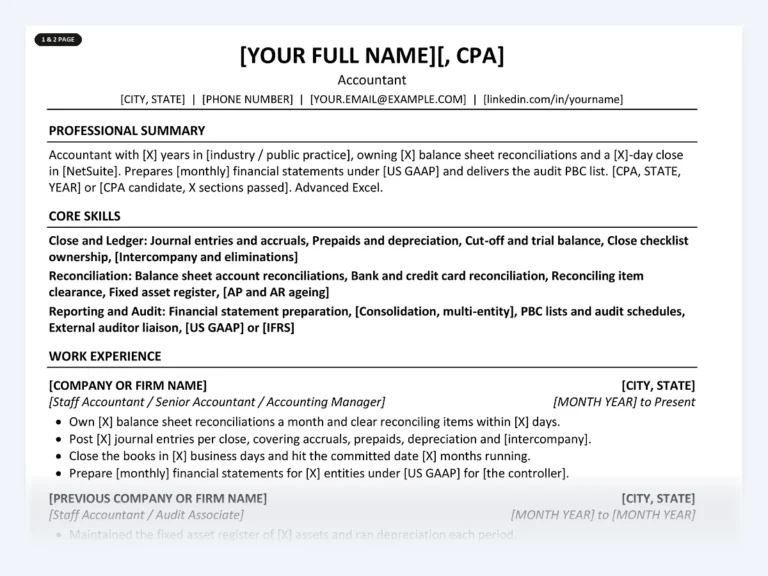
Accountant Resume Kit
Written around CPA status, named ERPs, reconciliations and the close. The Career Kit adds 48 bullets across four experience levels and an ATS keyword bank for accounting postings.
Want to see the writing first? The kit page has free sample bullets and keywords.
Accountant resume format and summary
Use reverse-chronological order with standard headings: Summary, Experience, Education, Certifications, Skills. Keep it single column with no tables or text boxes, because those are what commonly break parsing in an applicant tracking system. One page is right for entry level and staff roles; two is fine once you’ve owned a close and managed an audit.
Write the summary in three lines: years and setting, what you own in which system, and your credential status.
For more on the summary, see how to write a resume summary. To pull the exact terms from a posting, use resume keywords from a job description, and for bullet structure, resume bullet points.
Leave these off
- “CPA” after your name before the license is issued.
- Client names or financial figures your employer treats as confidential.
- “Improved efficiency” without the manual step you removed.
- Advanced Excel if you wouldn’t pass a live test.
- An accounting standard listed as a skill when you’ve only studied it.
Common questions
How do I list CPA exam progress on a resume?
Write “CPA candidate” with the sections passed and the month and year of each, plus the next one scheduled. Put it in the header area or the certifications section. Don’t write CPA after your name until your state board issues the license.
What skills should an accountant put on a resume?
Journal entries, balance sheet reconciliation, month-end close, financial statement preparation, audit support, and your ERP named as a product. Add the reporting basis (US GAAP or IFRS), SOX if you’ve worked under it, and Excel at the level you can prove.
What is the best format for an accountant resume?
Reverse-chronological, single column, with standard section headings and no tables or graphics. One page for entry level and staff roles, two pages once you have senior or management experience to show.
How do I write an accountant resume with no experience?
Lead with your degree, credit hours and any CPA sections passed, then list internships, tax clinic work and treasurer roles as experience entries with numbers. A part-time job where you balanced a till counts as reconciliation. Keep it to one page.
What’s the difference between an accountant and a bookkeeper resume?
A bookkeeper resume shows the day-to-day records: coding, bank reconciliations, payables, receivables, payroll and the owner’s report, usually in QuickBooks or Xero. An accountant resume shows the close, financial statements under a framework such as US GAAP, and the audit. Use the title the posting uses and the vocabulary that goes with it.
Start from an accountant resume that’s already written
The accountant kit has the CPA line, ERP names and close and reconciliation bullets in place, with brackets for your numbers. Edit it in Word or Google Docs tonight.
See the accountant kit
Written by
Founder, Disruptive Templates
Umair Sajid runs Disruptive Templates and has spent a decade in digital marketing, most of it looking at how people are found online. The resume templates here come from the same question asked of hiring software instead of search engines: what does the machine actually read?

Server Resume Examples: Covers, Checks and Upselling
Managers read a server resume for section size, covers per shift and how you move the check. Here are bracketed examples for casual, fine dining, banquet and bartender-server jobs.

Security Guard Resume Examples: License, Posts and Incidents
Recruiters at security companies check your guard card before anything else. Here is where it goes, with bullets for each post type, incident report wording and an armed version.

Project Manager Resume Examples: Scope, Budget and Delivery
Lead with your method and credential, give every project a size line, and write bullets about what the plan met in real life. With IT, construction and agile versions.