
Resume writing10 min read
Medical Assistant Resume Examples and Skills (With Bullets by Experience)
Start your medical assistant resume with your certification, written the way the awarding body does. Then show both the clinical and front-office halves of the job and pick bullets for your experience level.

On this page
Key takeaways
- Write your certification in the first line of your medical assistant resume, in its exact format: CMA (AAMA), RMA (AMT), CCMA (NHA) or NCMA (NCCT). A bare “CMA” is ambiguous.
- Show both halves of the job: clinical work like rooming and phlebotomy, and front-office work like prior authorizations and referrals.
- Match your bullets to your experience: externship and protocol work at year one, a provider’s full clinic day by year two or three, clinic flow and training by year five.
- Name the EHR and the point-of-care tests you run. “Epic” and “rapid strep” are searchable. “Computer skills” is not.
- Stay inside scope. Say “administered under standing orders”, never “assessed” or “diagnosed”.
A medical assistant resume gets read in a specific order: credential first, then whether you can cover both the back office and the front desk. The examples below follow that order, with bullets for one, two, five and ten years of experience and the skills clinic job ads actually list. If you’d rather start from a finished draft, the medical assistant resume template uses the same structure with the brackets ready for your details.
Put your certification in the first line, written exactly

Most clinics screen on certification before they read a single bullet. In most states medical assistants are not licensed, so certification is the credential that sorts the pile, and there are four common ones from four different bodies. They are not interchangeable, so write yours exactly as the awarding body does:
| Write it as | Full name | Awarded by |
|---|---|---|
| CMA (AAMA) | Certified Medical Assistant | American Association of Medical Assistants |
| RMA (AMT) | Registered Medical Assistant | American Medical Technologists |
| CCMA (NHA) | Certified Clinical Medical Assistant | National Healthcareer Association |
| NCMA (NCCT) | National Certified Medical Assistant | National Center for Competency Testing |
The awarding body in parentheses matters. “CMA” on its own is ambiguous: in long-term care it also stands for Certified Medication Aide, a different credential with a different scope. The AAMA writes its credential as CMA (AAMA), and its certification page says there must be no deviations from the designation format, so copy it character for character.
Put the credential after your name in the header, again in the first words of your summary, and in full in a certifications section with the number and expiry date. Three places is not overkill: a recruiter searching the applicant system for “CCMA” and a practice manager skimming the top third of the page are looking in different spots.
Not certified yet? Say where you are: “CMA (AAMA) exam scheduled [Month Year]” or “RMA (AMT) candidate, program completed [Month Year]”. Leaving it off makes the reader assume there’s no plan. For the summary itself, our guide on how to write a resume summary has the full method.
Show both halves: clinical and administrative

A medical assistant is half clinical and half administrative, often in the same shift. A resume that shows only one side describes half the job, and the applicant system will miss you when the posting searches for the other half.
| Back office (clinical) | Front office (administrative) |
|---|---|
| Rooming, vitals, med rec and allergy review | Scheduling across provider templates |
| Venipuncture, capillary sticks, order of draw | Insurance verification and eligibility |
| IM, subcutaneous and intradermal injections, immunizations | Prior authorizations and appeals |
| EKG with lead placement, spirometry, nebulizer treatments | Referral placement and follow-up |
| CLIA-waived tests: rapid strep, flu, urinalysis, glucose, A1c | Refill requests under protocol |
| Autoclave sterilization and spore test logs | CPT and ICD-10 entry for charge capture |
Then weight the page toward whatever the posting leads with. Federal postings show how far the split can go: the VA’s Medical Support Assistant series is almost entirely the administrative half, with duties like scheduling and checking patients in. A dermatology practice advertising for a back-office assistant wants procedure setup and specimen handling up top.
Use the posting’s job title, too. Medical assistant, clinical medical assistant and medical office assistant get searched as separate terms, so if the ad says “Clinical Medical Assistant”, your target title line should say that.
Medical assistant resume bullets by experience level

A good bullet names the task and the volume, then the system or standard behind it. Every number below is in brackets because it has to be yours. Pick the band closest to the job you’re applying for, not the job you have now. For the general method behind these, see how to write resume bullet points.
About one year: externship or first role
- Completed [160] externship hours at [clinic name] as part of a [CAAHEP / ABHES]-accredited medical assisting program.
- Roomed [15] patients a day, recording vitals and chief complaint in [Epic] before the provider entered.
- Drew blood by venipuncture and capillary stick after competency sign-off by [lead MA or supervisor].
- Gave [IM and subcutaneous] injections under standing orders for about [30] patients a week.
- Logged every autoclave cycle for [3] procedure rooms with no missed entries across [6] months.
Two to three years: running a provider’s day
- Ran [Dr. Name]’s clinic day on my own, rooming [24] patients and keeping the schedule within [10] minutes of time.
- Performed [40] venipunctures a week with a first-stick rate of [92]%.
- Gave [150] immunizations a month and reported each one to the [state] immunization registry.
- Processed [35] prior authorizations a week, following each to approval or appeal.
- Kept vaccine refrigerator temperature logs with [zero] excursions over [12] months.
About five years: lead medical assistant
- Assigned rooms and assistants each morning for [6] MAs supporting [5] providers.
- Held provider on-time start at [90]% across [40] sessions a week by resequencing room setup.
- Cut specimen rejections from [8] to [1] a month by retraining the team on labeling and order of draw.
- Ran recall calls to [200] patients a month to close [diabetic eye exam] gaps.
- Signed off [30] clinical competencies a year and kept training files ready for inspection.
Ten years and up: supervisor or clinical operations
- Supervised [18] medical assistants across [3] clinic sites as [clinical operations supervisor].
- Shortened time to independent rooming for new hires from [6] to [4] weeks with a structured shadowing plan.
- Prepared [3] sites for [CLIA] and [OSHA] inspections, closing [every] finding before the follow-up visit.
- Set one vaccine storage and handling standard across [3] sites after a [CDC guidance] update.
- Taught [2] cohorts in a [CAAHEP]-accredited medical assisting program.
Five bullets per band is a start. A full resume needs 12 to 15 across your jobs, and each one has to fit your specialty. Dermatology and orthopedic practices use different procedures, so a primary care bullet about A1c checks reads oddly on a dermatology application.
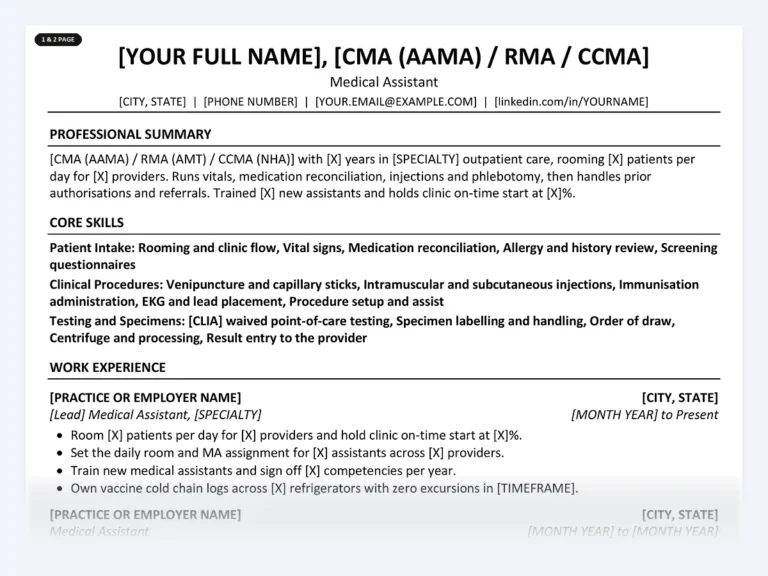
Medical Assistant Resume Kit
A finished one-page and two-page resume written for medical assistants, with the credential line, both halves of the job and bracketed numbers in place. The Career Kit adds a bullet library of 48 bullets across four experience levels.
Closer to one of these situations? There are kits for a certified medical assistant, an experienced medical assistant turning years into searchable skills, and a medical receptionist if the front office is where you want to stay.
Skills for a medical assistant resume that screeners search
Medical assistant skills for a resume are where the keyword search happens, so name things. “EHR proficiency” matches nothing specific; “Epic, athenahealth” matches the practice that uses them. Group the list the way a clinic day divides:
- Patient intake: rooming, vital signs, medication reconciliation, allergy and history review, depression and fall-risk screening
- Clinical procedures: venipuncture, capillary sticks, IM and subcutaneous injections, immunization administration, EKG, procedure setup
- Testing and specimens: CLIA-waived point-of-care tests (name them), order of draw, specimen labeling, centrifuge
- Administrative: scheduling, insurance eligibility, prior authorization, referral management, CPT and ICD-10 entry
- Systems and compliance: your EHR by name, HIPAA, OSHA bloodborne pathogens, vaccine cold chain and temperature logs
Soft skills work better as proof than as labels. “Calm with anxious patients” in a skills list is a claim; a bullet about giving [150] pediatric immunizations a month shows it. The same goes for “switching between front and back office”: prove it with one bullet from each side under the same job.
To find which terms a specific posting uses, paste it into the free ATS keyword checker next to your draft. Our post on pulling keywords from a job description shows where each one belongs on the page.
Medical assistant resume with no experience
If you’ve just finished a program, your training is your experience. Put it in its own section above any unrelated jobs: the program name, whether it’s CAAHEP- or ABHES-accredited, the completion date and the externship hours and site. Accreditation matters because it decides which exams you can sit, and hiring managers know that.
Then list competencies you were checked off on, not topics you covered. “Venipuncture, [30] supervised draws” says more than “phlebotomy coursework”. Keep recent customer service or caregiving jobs, too. A cashier who handled [200] transactions a shift has done front-desk volume, and clinics read that as relevant. There’s more on this in our guide to a resume with no experience.
A summary for this stage can be two lines:
What to leave off a medical assistant resume
- “CMA” without the awarding body
- A certification you haven’t passed yet, written as though you have (write “exam scheduled” instead)
- Assessment, diagnosis, triage decisions or anything that sounds like prescribing
- Patient names, dates or any detail that identifies a person
- First-stick rates or patient counts you can’t back up in an interview
- Typing speed and “Microsoft Office” in place of your EHR by name
- An objective statement, a photo, your date of birth or full street address
Common questions
Should a medical assistant resume be one page or two?
One page for most people under about five years of experience. Two pages make sense once you’re a lead or supervisor with training and inspection work to show. Don’t stretch to two pages by repeating the same rooming bullet under every job.
Where do BLS and a phlebotomy certificate go?
In the certifications section, under your main medical assistant credential. Write BLS as “Basic Life Support (BLS) Provider, American Heart Association” with the expiry date. If your state requires a separate phlebotomy certificate, list it by its exact state name.
Do I need to be certified to work as a medical assistant?
Not by law in most states, because medical assistants are unlicensed and work under a delegating provider. In practice many employers require or prefer certification and filter on it. If you’re working toward one, list it with the exam date so you still come up in the search.
Should my resume lean clinical or administrative?
Toward whichever half the posting leads with, but always show both. A practice that lists prior authorizations and referrals first wants the administrative bullets high on the page. One that lists injections and procedures first wants the clinical ones leading.
I want to become a nurse. Should I mention it?
If you’re enrolled, put it in the education section with an expected completion date. Keep the rest of the resume about the medical assistant work you’ve done, since that’s the job in front of you. Be ready to say how long you plan to stay, because the practice will ask.
Start from a finished medical assistant resume
The medical assistant kit has the credential line, both halves of the job and bullets for your experience level already written. You replace the brackets with your details in Word, Google Docs or Pages. The role page shows free sample bullets first.
See the medical assistant kit
Written by
Founder, Disruptive Templates
Umair Sajid runs Disruptive Templates and has spent a decade in digital marketing, most of it looking at how people are found online. The resume templates here come from the same question asked of hiring software instead of search engines: what does the machine actually read?

Accountant Resume Examples: Entry Level to CPA
A controller wants three answers from your accountant resume: CPA status, the ERP you've closed the books in, and what you own. Here are examples that give them, from a…

Server Resume Examples: Covers, Checks and Upselling
Managers read a server resume for section size, covers per shift and how you move the check. Here are bracketed examples for casual, fine dining, banquet and bartender-server jobs.

Security Guard Resume Examples: License, Posts and Incidents
Recruiters at security companies check your guard card before anything else. Here is where it goes, with bullets for each post type, incident report wording and an armed version.