
Resume writing14 min read
Skills for a Resume: What to List for Your Job (With Examples)
List the skills your job ad names, in its words, and prove each one in a bullet. Hard vs soft skills, where each goes, and what leads the list in your field.

On this page
Key takeaways
- The best skills for a resume are the ones the job ad names, written in the ad’s own words. Pull them from three or four postings for your title.
- Hard skills and named tools go in a short, grouped skills section. Soft skills belong inside work bullets, where you can prove them.
- Every skill you list should show up again somewhere else on the page: in a bullet, a certification line or the summary.
- What leads the list depends on the job. Nurses lead with the license, engineers with the stack, trades with the process or equipment.
- Leave off anything every applicant has, anything you couldn’t do unsupervised next week, and skill bars or star ratings.
The skills for a resume that matter are the ones your target job ad asks for, in its exact words. They come in three kinds. Hard skills are the tasks of the job, such as payroll or medication administration. Tools are the named software and equipment, such as Epic or a forklift. Soft skills are how you work with people, such as de-escalation.
List hard skills and tools in a grouped skills section, and prove soft skills inside your bullets. Below are lists by job family, each linked to the resume template for your job title.
Skills for a resume: hard skills, soft skills and tools

A resume skill is anything a hiring manager could test in your first month. That definition throws out most of what fills skills sections, like “hardworking” and “team player”, and keeps what a screener actually looks for.
Recruiters sort skills into four kinds, whether or not they use these names. Each one earns its place on the page in a different way.
| Kind of skill | Examples | Where it goes | How a screener checks it |
|---|---|---|---|
| Hard skills | Medication administration, SQL queries, TIG welding, payroll processing | Skills section and bullets | Keyword search, then a technical question |
| Tools and systems | Epic, Salesforce, Primavera P6, QuickBooks, Zendesk | Skills section, by product name | Keyword search on the exact product |
| Licenses and certifications | RN license, PMP, CDL Class A, CMA (AAMA) | Their own section near the top | Verified against a registry or the certificate |
| Soft skills | De-escalation, prioritizing, explaining a decision to a customer | Inside bullets, with a result | Behavioral interview questions |
The difference that matters most is between the first three rows and the last. A hard skill, a tool or a license is a checkable claim. A soft skill written as a single word is not, so on its own it adds almost nothing. That doesn’t make soft skills worthless. It means they need a different format, which we cover below.
Hard skills for a resume
Hard skills are the tasks of the job itself. The trick is to write them at the level a practitioner would use. “Accounting” is a field. “Month-end close, bank reconciliations, accruals” is a list of hard skills an accounting manager can read in two seconds and believe. Go one level down from the category every time.
Soft skills for a resume
Soft skills are how you work with people and pressure. The ones worth naming are specific to the job’s hardest moments. A contact center rep who can calm an angry caller, a teacher assistant who keeps a behavior plan running when the lead teacher is out, a project manager who tells a sponsor the date won’t hold: each of these is a soft skill, and each is more useful written as an event than as an adjective.
Where each skill goes on your resume
Skills show up in four places on a strong resume, and a good skill appears in at least two of them. A reader who sees “Excel” in the skills list and then again in a bullet about a monthly report believes it. A reader who sees it only in the list has to trust you.
- Summary. Name your two or three strongest skills in the first lines, in the posting’s words. This is the part a recruiter reads first.
- Licenses and certifications. Give credentials their own short section near the top when the job requires one. Screeners check it before anything else in licensed fields.
- Skills section. Six to twelve items, grouped by type, titled plainly as “Skills” or “Technical skills”. This is the list a parser and a keyword search read most easily.
- Experience bullets. This is where you prove the skill: what you did with it, how often or how much, and what changed.
Group the skills section the way the work divides, not as one long line of commas. A registered nurse might group it as assessment, medications, equipment and charting. A bookkeeper might use ledger, reconciliation, payables and payroll. Grouping shows that you know the shape of the job, and it makes the list easy to scan.
How many skills to put on a resume depends on the field. Six to twelve fits most jobs. Technical roles can list more if the groups are clear. The ceiling is simple: list only what you could do without supervision next week, because an interview will test whatever looks most impressive.
How to prove a skill in a bullet

A skill becomes believable when a bullet shows it doing a job at a stated scale. The formula is short: the skill in action, the size of the work, and what happened because of it. Keep your real figures in the brackets.
Look at what happened to the soft skills. “Problem solving” became a resolution rate. “Leadership” became running a process that other people had to follow. Neither rewrite uses the original adjective, and both prove it better than the adjective could.
Numbers help, but only numbers you can explain. If you don’t know a figure, estimate it honestly from something you do know (patients per shift, tickets per day, invoices per week) or describe the scope instead. Our guide to resume bullet points covers the structure in more depth.
See which skills the job ad names
Paste a job description and your resume into the free ATS keyword checker. It lists the skills and tools in the ad that your resume doesn’t mention yet.
Check my resume against a job adHow to find the right skills for your job
Build your list from job ads, not from generic lists of skills. A generic list gives you words like “adaptability”. A posting gives you the words the employer’s system will search for. Here is the method, and it takes about twenty minutes.
- Collect three or four postings for the exact title you want, at the level you’re applying for.
- Highlight every skill, tool and credential in the requirements and duties sections.
- Count repeats. Anything that appears in most of the ads is a core skill. Put it in your summary or at the top of its group.
- Copy the wording. If the ads say “Microsoft 365”, don’t write “MS Office”. If they say “patient intake”, don’t write “front desk duties”.
- Cross off what you can’t back up. A skill without a bullet or a credential behind it is a liability in the interview.
Our guide to resume keywords from a job description walks through this with a worked example, and tailoring your resume to the job description covers the parts of the page to change for each application.
Examples of skills for a resume by job family

What leads the skills list changes completely from one field to the next. In some jobs it’s a license, in others a piece of software or a type of equipment. When we researched real postings for each role, the first filter was different in almost every family. This table routes you to the role page for your job, where you’ll find free sample bullets and keywords.
| Job title | Industry | What the kit leads with |
|---|---|---|
| Registered nurse | Healthcare | RN license, state and compact status, then the EHR by name |
| Medical assistant | Healthcare | The exact credential: CMA (AAMA), RMA (AMT) or CCMA (NHA) |
| Certified nursing assistant | Healthcare | State registry listing and expiry date, then lift equipment |
| Software engineer | Technology | Languages, frameworks and cloud as postings name them, then design |
| Data analyst | Data | SQL first, then one named BI tool |
| IT support specialist | Technology | The ticketing, directory and device tools by product name |
| Customer service representative | Customer service | Resolution first, then paired metrics, then channels |
| Cashier | Retail | Register exceptions, compliance and self-checkout |
| Administrative assistant | Office and admin | Who you support and at what level, then calendar and travel |
| Accountant | Finance | Close, reconciliation and reporting, with the ERP named |
| Teacher | Education | License, endorsement and grade band |
| Teacher assistant | Education | How you meet the ESSA paraprofessional requirement |
| Project manager | Project management | Methodology and PMP or PRINCE2, then project values |
| Electrician | Skilled trades | Installation and troubleshooting as separate groups, code work |
| Welder | Skilled trades | Processes in code letters and shop names, then positions |
| Truck driver | Transport | Equipment type and verifiable months, then compliance |
| Warehouse worker | Logistics | Picking, receiving and inventory accuracy, then equipment |
| Marketing manager | Marketing | Demand and budget before channels |
| Graphic designer | Design | Portfolio link and the Adobe applications by name |
| Sales representative | Sales | The territory, then the customer base and quota |
| Recruiter | Human resources | Intake with the hiring manager, then sourcing |
| Bartender | Hospitality | Alcohol server certification and state, then volume |
| Paralegal | Legal | Docket and deadlines, then discovery |
| Security guard | Security | Patrol, access control and incident reporting |
Not listed? Browse resume templates by industry to find your job title.
Skills lists by job family
This is the short version for the biggest families: the hard skills to list, the tools to name as products, and the soft skill worth proving in a bullet.
| Job family | Hard skills | Tools to name | Soft skill to prove |
|---|---|---|---|
| Nursing | Head-to-toe assessment, medication administration, discharge teaching | Epic, Cerner or Meditech; BCMA; Pyxis or Omnicell | Escalating a change in condition early |
| Software | API design, automated testing, incident response | Languages as posted, AWS or Azure, Docker, GitHub Actions | Code review feedback other engineers acted on |
| Customer service | Complaint resolution, billing adjustments, returns | Zendesk, Salesforce, Five9 or Genesys | Calming an angry caller without escalating |
| Office and admin | Calendar management, travel coordination, invoice processing | Outlook, SharePoint, Concur | Deciding what reaches the executive and what waits |
| Accounting | Month-end close, reconciliations, accruals | Your ERP by name, Excel | Explaining a variance to a non-accountant |
| Teaching | Lesson planning, formative assessment, differentiation | Your district’s learning platform by name | Keeping parents informed before problems grow |
| Project management | Scheduling, budget tracking, change control, risk register | Microsoft Project, Smartsheet, Primavera P6, Jira | Telling a sponsor the date won’t hold |
| Electrical trades | Installation, troubleshooting, code-compliant wiring | The meters and testers you’re trained on | Explaining a fault and its fix to a customer |
| Trucking | Pre-trip inspection, load securement, route planning | ELD system by name; CDL class and endorsements | Staying on schedule within hours-of-service limits |
Healthcare skills
Clinical hiring runs on credentials, so the license or certification comes before any skill. A registered nurse should put RN, the state and multistate compact status in the first lines. A VA registered nurse announcement asks for “current, full, active, and unrestricted registration” in a US state or territory (USAJOBS), and a Walter Reed nursing posting required ACLS “within 6 months of employment” (USAJOBS). After the license, list these:
- The EHR by product name: Epic, Cerner or Meditech, not “EHR”
- BLS and ACLS, with the issuing body, such as the American Heart Association
- Barcode medication administration and dispensing cabinets such as Pyxis or Omnicell
- Scoring tools you use every shift, such as Braden, Morse Fall Scale or CIWA-Ar
- Delegation to nursing assistants and LPNs, since that is part of the RN’s scope
For a medical assistant, write the credential in full, because CMA (AAMA), RMA (AMT) and CCMA (NHA) are different certifications and clinics filter on them separately. Then show both halves of the job: rooming and vitals, and the front-office side such as scheduling and prior authorizations.
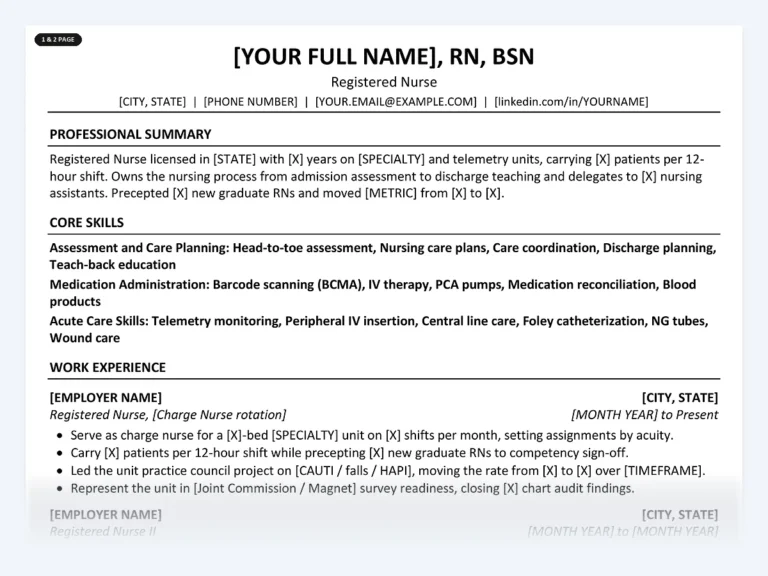
Registered Nurse Resume Kit
The license line, compact status and EHR are already placed where a nurse recruiter looks first, with bullets for new grads through charge nurses. You replace the brackets with your unit, patient load and numbers.
Technology and data skills
For a software engineer, languages, frameworks and cloud platforms are the first filter, and they should match the posting exactly. JavaScript and TypeScript are different search terms. After the stack, show the skills that separate levels: testing, code review, on-call and incident work, and system design choices such as caching, queues and database selection. Five languages you can defend beat twenty you touched once.
A data analyst leads with SQL and one BI tool, such as Tableau or Power BI. Show SQL depth with the terms that prove it, like window functions and CTEs. For office software, program by program, see our full guide to computer skills for a resume.
Customer service and retail skills
The commonest mistake here is leading with the software. A customer service representative should lead with resolution: what you could fix alone, and how often you fixed it on the first contact. Keep the metrics in pairs, first contact resolution next to handle time and quality score next to CSAT, because a single flattering figure reads as half the story to anyone who has run a contact center. Name channels next (phone, chat, email), and say whether chats were concurrent.
The U.S. Bureau of Labor Statistics lists referring customers to supervisors as one of the occupation’s duties (BLS). So the limit of your authority is a real skill line: “Approve credits up to [$150] without escalation.” Our guide to customer service resume skills has the full list by channel.
Education, project and trades skills
A teacher leads with the license, the subject endorsement and the grade band, because a district can’t shortlist you for a post you aren’t certified to hold. A teacher assistant in a Title I school should state how they meet the ESSA paraprofessional requirement, such as an associate degree or a passed assessment; our post on teacher resume skills has lists by grade level.
A project manager leads with the delivery method and PMP or PRINCE2, then project values, because “managed projects” can mean a two-week office move or a multi-year program. In the trades, write each process both ways: a welder lists “GMAW (MIG)”, because postings use both and keyword matching is literal.
Soft skills worth putting on a resume
Name a soft skill only when it is part of the job’s hardest moment, and then prove it with an event. These are the soft skills that come up again and again in the postings we studied, with the kind of evidence that makes each one believable.
| Soft skill | Prove it with |
|---|---|
| De-escalation | Complaints resolved without escalation, or a named difficult situation and its outcome |
| Prioritizing under pressure | Patient load, ticket queue, orders per shift, or deadlines met in a busy period |
| Written communication | Reports, procedures or handover notes other people relied on |
| Training others | New hires or students you onboarded, and how quickly they worked alone |
| Delivering bad news | A date, budget or decision you escalated early, and what the sponsor or customer did with it |
| Attention to detail | An error rate, an audit result, or a mistake you caught before it shipped |
If a soft skill appears in the job ad in so many words, such as “strong communication skills”, it’s fine to include the phrase once in your summary so the keyword search finds it. Then let the bullets do the proving.
Skills to leave off your resume
Cut anything that every applicant has, anything you can’t back up, and anything a parser can’t read. These entries take space and lower the reader’s trust in the rest of the list:
- Hardworking, motivated, team player and other adjectives with no proof
- Email, internet browsing and “computer literate”
- “Microsoft Office” with no program named
- Skill bars, star ratings and percentages, which parsers can’t read and interviewers question
- Languages, tools or methods from one tutorial or one course project
- Certifications that have expired, or that you plan to take without a booked date
- Skills that belong to a different job, such as roadmap ownership on a project manager resume
One exception: if a posting explicitly asks for something basic, like typing speed for a data entry role, include it with a measured figure. The rule is to answer the ad, not to follow a list.
Common questions
What are the best skills to put on a resume?
The best skills are the ones your target job ad names, written in its exact words, that you can prove in a bullet. For most jobs that means hard skills and named tools first, then a license or certification if the field requires one. Soft skills work best shown inside bullets.
How many skills should I list on a resume?
Six to twelve fits most jobs, grouped by type. Technical roles can list more if the groups are clear. List only what you could do without supervision next week, because interviews test what you list.
Should soft skills go in the skills section?
Mostly no. A one-word soft skill in a list is easy to claim and impossible to check. Show soft skills in your experience bullets with a result, and include a soft-skill phrase in your summary only when the job ad uses it word for word.
What is the difference between hard skills and soft skills?
Hard skills are the tasks and tools of the job, such as payroll processing, SQL or medication administration, and they can be tested directly. Soft skills describe how you work with people and pressure, such as de-escalation or prioritizing, and they are judged through examples and interview questions.
Where should the skills section go on a resume?
Below the summary for technical and licensed roles, where the screener checks the stack or the credential first. Below the experience section for most other jobs, where the skills list confirms what the bullets already show.
Find the skills for your job title, already written
Every role page shows the skills and keywords its postings screen for, with free sample bullets you can use today. If you want the whole resume, the kit has it drafted for your job with brackets for your own numbers, in Word files that open in Word, Google Docs or Pages. There’s no account to create.
Find your job title
Written by
Founder, Disruptive Templates
Umair Sajid runs Disruptive Templates and has spent a decade in digital marketing, most of it looking at how people are found online. The resume templates here come from the same question asked of hiring software instead of search engines: what does the machine actually read?

Server Resume Examples: Covers, Checks and Upselling
Managers read a server resume for section size, covers per shift and how you move the check. Here are bracketed examples for casual, fine dining, banquet and bartender-server jobs.

Security Guard Resume Examples: License, Posts and Incidents
Recruiters at security companies check your guard card before anything else. Here is where it goes, with bullets for each post type, incident report wording and an armed version.

Project Manager Resume Examples: Scope, Budget and Delivery
Lead with your method and credential, give every project a size line, and write bullets about what the plan met in real life. With IT, construction and agile versions.